



Air Fryer Salmon Bites with Honey Mustard & Asparagus

4.9 ★
0 people reviewed 🎉 Thanks for review!
Lauren Hayes
Written By Lauren Hayes ✓
Lauren Hayes
Recipe Developer & Culinary Editor

Lauren develops and reviews GLPIANS recipes with a focus on ingredient accuracy, cooking technique, texture, timing, portioning, and reliable home-kitchen execution.

Melissa Grant, MS, RDN
Reviewed By Melissa Grant, MS, RDN ✓
Melissa Grant, MS, RDN
Registered Dietitian Nutritionist

Melissa reviews GLPIANS content for nutrition accuracy, responsible GLP-1 framing, portion guidance, and evidence-based communication.

Daniel Harper, MPH
Fact Checked By Daniel Harper, MPH ✓
Daniel Harper, MPH
Food Safety & Health Fact Checker

Daniel reviews GLPIANS content for food-safety accuracy, including cooking temperatures, food handling, storage, reheating, and source-backed safety guidance.

Honey Mustard Salmon Bites for a Smaller Dinner

These air-fryer honey mustard salmon bites pair a tangy-sweet glaze with asparagus in a small-batch dinner. Plan on about 20 minutes total, including approximately 10 minutes of cooking, when everything fits in one uncrowded basket. Each of the two portions provides an estimated 27 grams of protein, calculated from the complete recipe.

The fish is cut into manageable pieces rather than served as one large fillet. A little glaze cooks onto the salmon, while a separately reserved spoonful adds the finishing flavor.

A Different Protein Option When Chicken Does Not Appeal

A smaller appetite does not always mean the same foods remain appealing. GLP-1 nutrition guidance recognizes changes in food preferences and emphasizes adaptable eating patterns and adequate nutrition. This recipe offers a different protein, texture, and portion format—not a treatment for food aversion or medication side effects. (PubMed Central (PMC))

The practical advantage is choice. You can keep the asparagus separate, use the finishing sauce as a dip, or begin with a few bites without facing a large mixed plate.

There is no requirement to choose salmon when fish itself sounds unappealing.
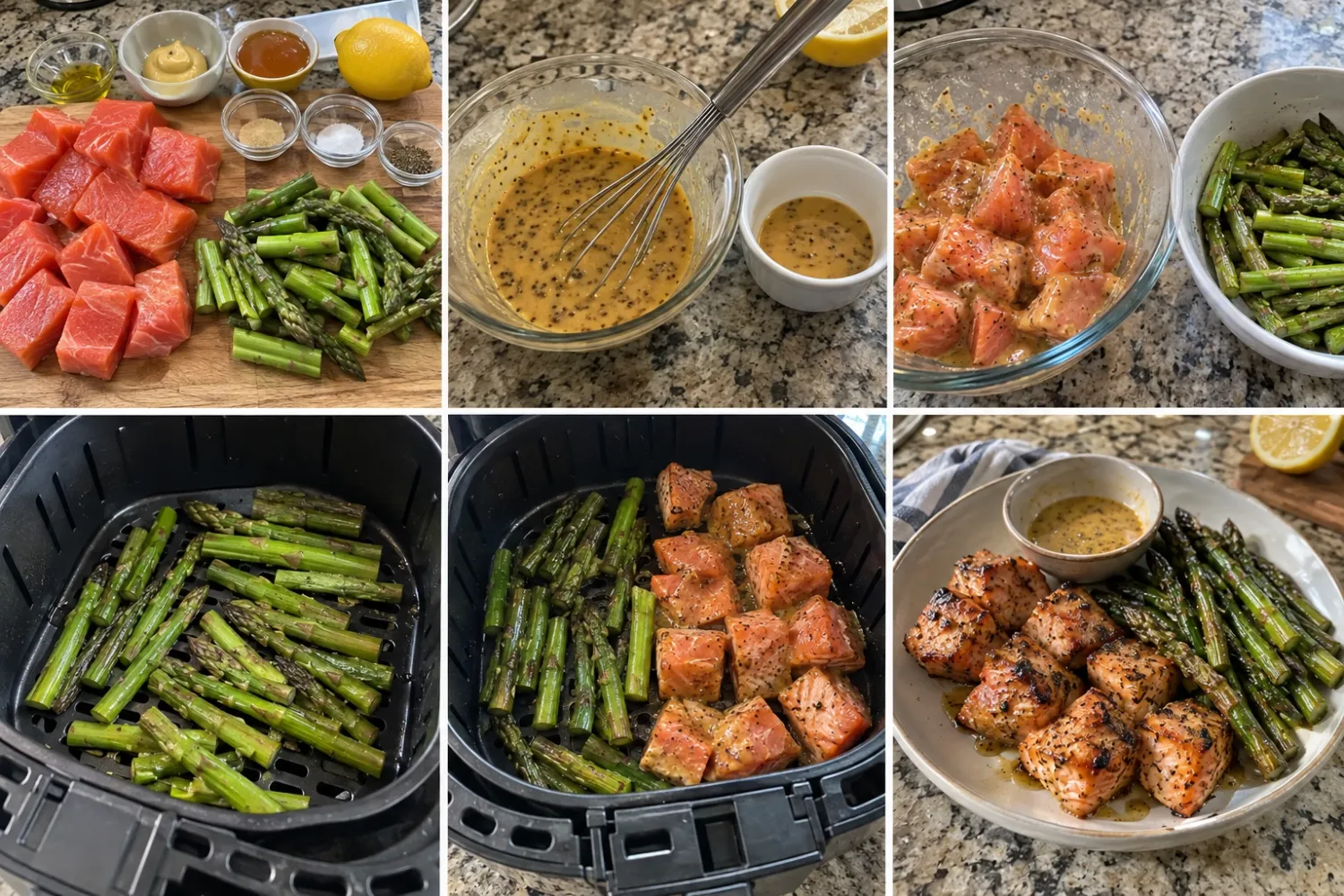
Process of making honey mustard salmon bites with asparagus

What Makes This Version Different

The Vegetable Gets a Head Start

The asparagus begins cooking before the salmon is added. That separates the cooking schedules slightly, rather than leaving the fish in the fryer until a thick vegetable finally softens.

Medium asparagus works best with the baseline timing. Particularly thin spears need less time; thick stalks may need more. Once the salmon reaches its safe endpoint, remove it instead of waiting for the vegetables.

Some Sauce Stays Out of the Air Fryer

Reserving a small amount of glaze before handling raw fish gives the finished bites their final honey-mustard flavor without requiring a thick coating during cooking.

The finished texture should be lightly glazed and flaky. These bites are not breaded, so they will not have the crust of fried fish nuggets.

The Salmon Type Is Specified

The nutrition estimate uses sockeye salmon, not an unspecified salmon average. Another plain salmon fillet can work, but its nutrition should not be assumed identical.

Whole-grain Dijon is also an option when a textured glaze sounds appealing. Maple syrup can replace the honey for a different variation, rather than an identical result.

How to Serve a Modest Portion Without Guessing

Each serving begins with 4 ounces of raw, skinless salmon. Cooking changes its weight, so that does not mean the plate contains 4 ounces of cooked fish.

For planning, expect roughly 3 ounces of cooked salmon per portion, with the actual amount depending on moisture loss. Divide the finished batch evenly; use a scale when a specific cooked weight matters.

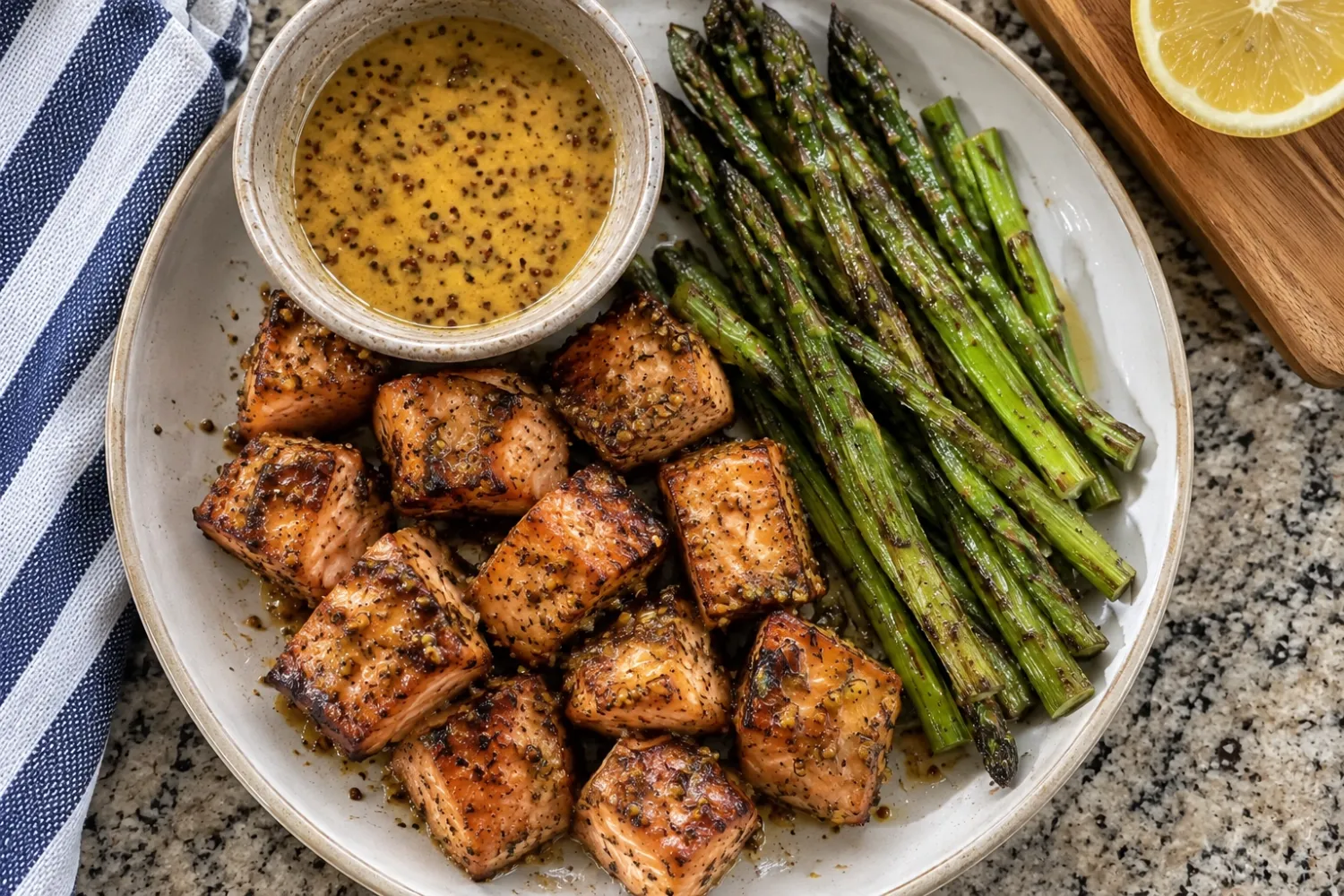
Arrange the bites in one layer next to the asparagus. A small plate keeps the components easy to see and select. This is a presentation suggestion, not a proven method of changing appetite or digestion.

A smaller starting portion is not a limit on how much someone should eat. Add more food or an appropriate side when needed.

Making It a More Substantial Meal

Cooked rice or quinoa can turn the salmon and asparagus into a larger meal without changing the fish preparation. Keep the grain alongside the fish so each component remains easy to portion.

For a separate recipe already built around salmon and rice, the Honey Garlic Salmon Rice Bowl offers a different glaze and bowl format.

Preparing Ahead and Saving the Second Portion

The glaze and trimmed asparagus can be prepared the day before and refrigerated separately. Coat the fish shortly before cooking.

After cooking, refrigerate leftovers promptly in shallow containers and use them within 3–4 days. Reheat only the portion needed, using short microwave intervals and a 165°F internal-temperature check. (Food Safety and Inspection Service)

The published nutrition includes the salmon, asparagus, oil, and complete glaze. Rice, quinoa, and other additions require their own nutrition allowance.
GLPIANS
Professional Recipe Collection
Honey mustard salmon bites with lightly browned edges and asparagus pieces on a small plate.
AIR-FRYER SEAFOOD DINNER

Air-Fryer Honey Mustard Salmon Bites with Asparagus

Bite-sized sockeye salmon coated in a light honey-Dijon glaze and air-fried alongside asparagus. A small amount of clean, reserved sauce adds a tangy-sweet finish.

Servings
2
Yield 2 servings
Prep Time 10 mins
Cook Time 10 mins
Total Time 20 mins
Course Dinner
Cuisine American

Ingredients

Glaze Division: Reserve 2 teaspoons of the mixed glaze before adding any raw salmon. Use the remainder to coat the fish. The reserved glaze provides 1 teaspoon of finishing sauce per serving.

Equipment

Basket-style air fryer (6 qt+ recommended)
Thin-tip instant-read food thermometer
Cutting board and sharp knife
Two mixing bowls & small cups
Measuring spoons & tongs
Kitchen scale

Instructions

  • 1
    Preheat and prepare. Preheat the air fryer to 375°F according to its instructions while preparing the ingredients. Use a basket large enough to hold the salmon and asparagus side by side without stacking. Check the salmon for remaining pin bones, pat it dry, and cut it into approximately 1-inch pieces of similar thickness.
  • 2
    Mix and divide the glaze. In a small bowl, stir together the Dijon mustard, honey, lemon juice, garlic powder, and 1/2 teaspoon olive oil. Transfer 2 teaspoons of glaze to a separate clean cup for serving. Add the remaining glaze to the salmon in a mixing bowl and gently coat the pieces. Keep the reserved sauce and its spoon away from raw fish.
  • 3
    Start the asparagus. Toss the prepared asparagus with the remaining 1/2 teaspoon olive oil, the salt, and the black pepper. Arrange it in a shallow layer on one side of the basket, leaving room for the fish. Air-fry at 375°F for 2 minutes.
  • 4
    Add the salmon. Place the salmon pieces on the empty side of the basket in a single layer, with small gaps between them. Do not place salmon on top of asparagus or pour pooled raw-fish glaze into the basket. Air-fry at 375°F for approximately 6–8 minutes, gently turning the asparagus after about 4 minutes. Leave the salmon pieces in place unless they need repositioning for even cooking.
  • 5
    Check doneness rather than relying on the timer. Begin checking the salmon after 5 minutes of cooking the fish. Insert a thin-tip food thermometer sideways into the center of several of the largest pieces. Cook until the centers reach 145°F, continuing in 1-minute increments as needed. The fish should separate into flakes, and the asparagus should be fork-tender with a slight bite. Remove any finished salmon pieces promptly; asparagus that needs more time can continue cooking separately. (FoodSafety.gov)
  • 6
    Finish and serve. Divide the salmon and asparagus equally between plates. Spoon 1 teaspoon of the clean reserved glaze over each portion. Serve warm. Discard any sauce remaining in the bowl that held raw salmon.

Recipe Notes

  • Expected texture: These are lightly glazed, unbreaded salmon bites—not crunchy fish nuggets. Aim for gently browned edges and a flaky center rather than a dark crust.
  • Choose even pieces: Very thin tail pieces will finish sooner than thick center-cut pieces. Do not keep smaller pieces cooking simply to match the color of larger ones.
  • Match the asparagus: Medium spears suit the brief head start. Very thin asparagus can go in with the salmon instead. Thick stalks may need additional cooking after the fish is removed.
  • Raw weight is not cooked weight: Each serving starts with 4 ounces of raw salmon. About 3 ounces cooked is a reasonable planning estimate, not a measured yield. The authoritative serving remains one-half of the finished recipe.
  • Do not portion by a fixed number of bites: Piece count changes with the fillet’s shape. Divide the cooked fish evenly, or weigh it when precision matters.
  • Added oil: The entire recipe uses 1 teaspoon of olive oil. That does not make the finished meal fat-free or establish a low-fat claim.
  • Allergens and dietary classification: Contains fish, specifically salmon, and mustard. The base recipe is pescatarian and contains no dairy ingredients. Do not automatically apply a gluten-free label without checking the selected products and preparation environment.

Nutrition Facts

Estimated nutrition per serving (1/2 of recipe):
NutrientAmount
Calories220 kcal
Protein27 g
Carbohydrates10 g
NutrientAmount
Fat8 g
Fiber2 g
Sugar7 g
NutrientAmount
Sodium410 mg

Substitutions

  • 8 oz sockeye salmon: 8 oz another plain, raw, skinless salmon fillet (nutrition will vary).
  • 1 tbsp smooth Dijon: 1 tbsp whole-grain Dijon (seedier coating).
  • 2 tsp honey: 2 tsp pure maple syrup (creates a thinner maple-mustard variation).

Substitutions are culinary alternatives, not medically equivalent choices.

Storage

Transfer leftovers to shallow, covered containers and refrigerate at 40°F or below within 2 hours. Use refrigerated leftovers within 3–4 days.

Reheating

Place one portion in a vented microwave-safe dish. Heat at approx 50% power for 45 seconds, then in 20–30-second intervals until 165°F internally. Avoid extra heating solely to recreate browned edges.

Make Ahead / Meal Prep

  • Mix the glaze and prepare the asparagus up to 1 day ahead. Store separately in the refrigerator.
  • Keep raw salmon separate; coat it shortly before cooking rather than storing it in the lemon-mustard mixture overnight.
  • For fresh fish, plan to cook it within 2 days of purchase when held at 40°F.
  • For cooked meal prep, portion and refrigerate as described in storage guidelines.

Serving Suggestions

Practical ways to present this small protein-and-vegetable meal:

  • Serve one portion on a small plate with the salmon and asparagus arranged separately rather than piled into a deep bowl.
  • Keep the finishing glaze on the fish or serve that measured teaspoon alongside for dipping.
  • For a more substantial meal, add a personally suitable side, such as 1/4–1/2 cup cooked rice or quinoa.
  • Additional sides are not included in the baseline nutrition estimate.
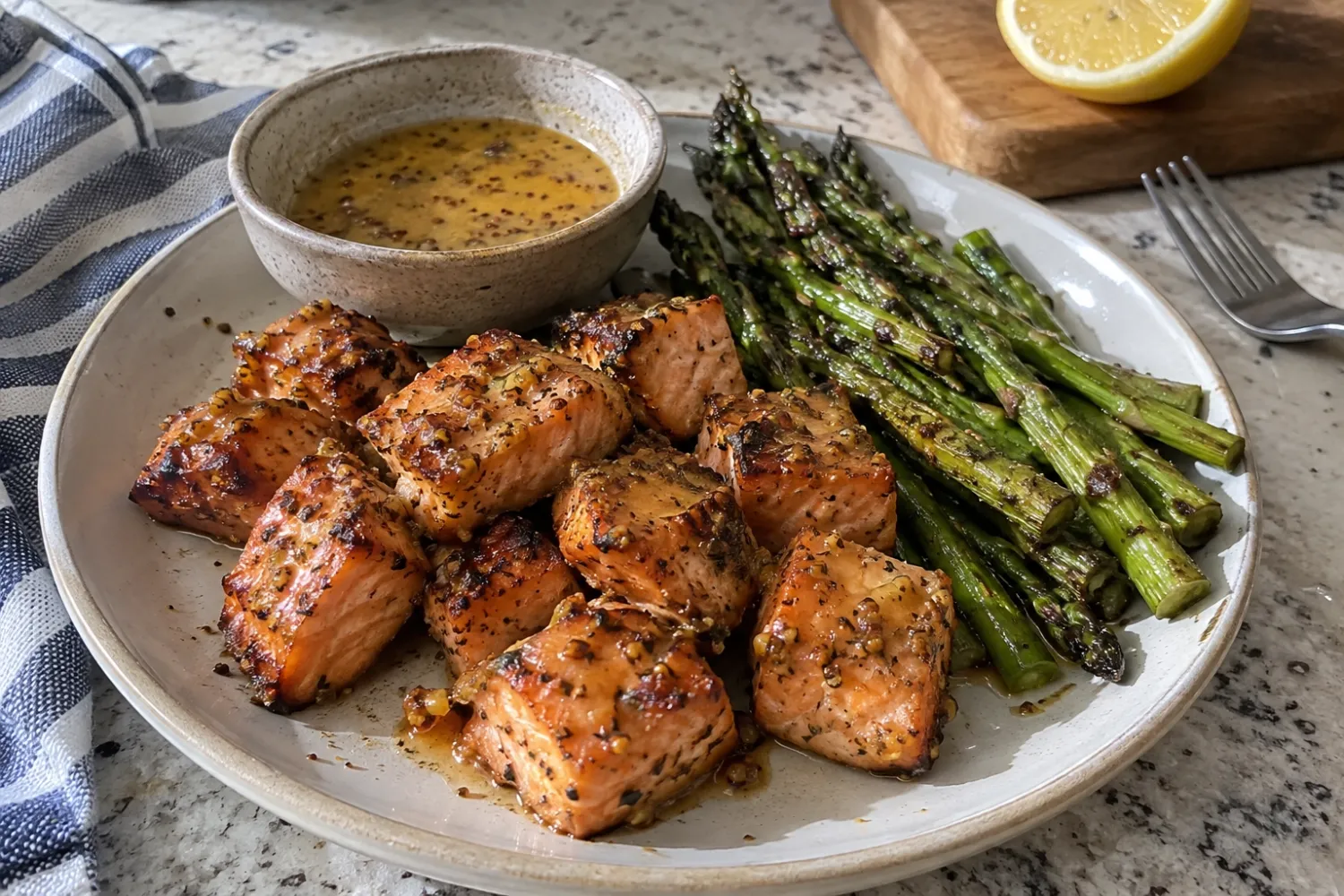
Serving view of Air-Fryer Honey Mustard Salmon Bites with Asparagus

When the Fish and Asparagus Finish at Different Times

Remove the salmon when it reaches 145°F, even when the asparagus needs longer. The vegetables can continue cooking on their own. Keeping everything in the basket until every piece looks equally browned can overcook the fish. (FoodSafety.gov)

For the next batch, choose asparagus of more consistent thickness and avoid mixing very thin salmon pieces with thick cubes.

Common Texture Problems

The Bites Are Dry

Check whether the pieces were thinner than expected or left cooking after reaching their endpoint. Begin checking early and remove finished pieces individually when necessary.

The Surface Is Pale

The basket may be crowded, the fish may have been wet, or excess sauce may have pooled beneath it. Pat the salmon dry and leave space around the pieces. Do not keep fully cooked fish heating simply to achieve a darker photograph.

The Asparagus Is Tough

Woody ends or unusually thick stalks may be responsible. Trim thoroughly and give thick asparagus additional time after removing the salmon.

Another Option When a Warm Meal Does Not Appeal

For a different preparation and serving temperature, the Chilled Shrimp Bento Box combines ready-to-eat cooked shrimp with separate cold components and requires no cooking at mealtime.

Choose according to personal preference rather than assuming either recipe is easier to digest.

Keep the Portion Flexible

This recipe is a food option, not a complete nutrition plan. Regular difficulty eating enough deserves individualized guidance from the prescribing clinician or a registered dietitian, rather than increasingly restrictive portions. (PubMed Central (PMC))

Frequently Asked Questions

What air-fryer temperature helps keep salmon bites from drying out?

This recipe uses 375°F. Begin checking the salmon after 5 minutes; the expected fish-cooking time is approximately 6–8 minutes. No temperature guarantees moist fish. Even piece size and removing the salmon when its center reaches 145°F are more useful than waiting for a particular surface color. (FoodSafety.gov)

Is this a 12-minute dinner?

Not from start to finish. The estimated cooking time is about 10 minutes, but preparation brings the total to approximately 20 minutes for one batch. Thawing, a crowded basket, or additional batches will add time.

How can bite-sized salmon help when a large piece of meat feels unappealing?

The smaller pieces offer a different texture and an easier-to-adjust presentation. A reader can select a few bites and keep the vegetable separate. That may suit personal preference, but it does not establish that salmon overcomes food aversion or treats medication side effects.

Is fish easier to digest than chicken during GLP-1 treatment?

That should not be assumed. The evidence reviewed for this recipe does not establish a salmon-versus-chicken digestive advantage in GLP-1 users. Research on GLP-1 medications and gastric emptying does not validate a claim that this salmon recipe prevents stomach heaviness. Food preference and digestive tolerance are not interchangeable measures. (Springer)

How much protein is in one serving?

One-half of the complete recipe provides an estimated 27 grams of protein. That serving is prepared from 4 ounces of raw sockeye salmon and includes half the asparagus and glaze. A smaller fraction of the recipe provides proportionately less protein.

Can I use frozen salmon?

Yes, after thawing it. The recipe’s timing is not written for frozen cubes or frozen fillets. Follow the package directions and remove vacuum-packed fish from reduced-oxygen packaging before refrigerator thawing. Pat the thawed salmon dry before coating it. (Michigan State University Extension)

Can I double the recipe in the same basket?

Only when the larger quantity still fits in one uncrowded layer. Otherwise, cook separate batches. Double the ingredient quantities, not the temperature or the programmed cooking time for each batch.

Your Next Meal Plan

Build variety into your dinner rotation with different proteins, textures, and preparation methods. Browse these high-protein GLP-1 dinner recipes for another meal to suit your preferences.

Explore High-Protein GLP-1 Dinner Recipes
Link copied to clipboard!