
GLP-1 Dose Calculator: Understand Dose, Volume & Concentration
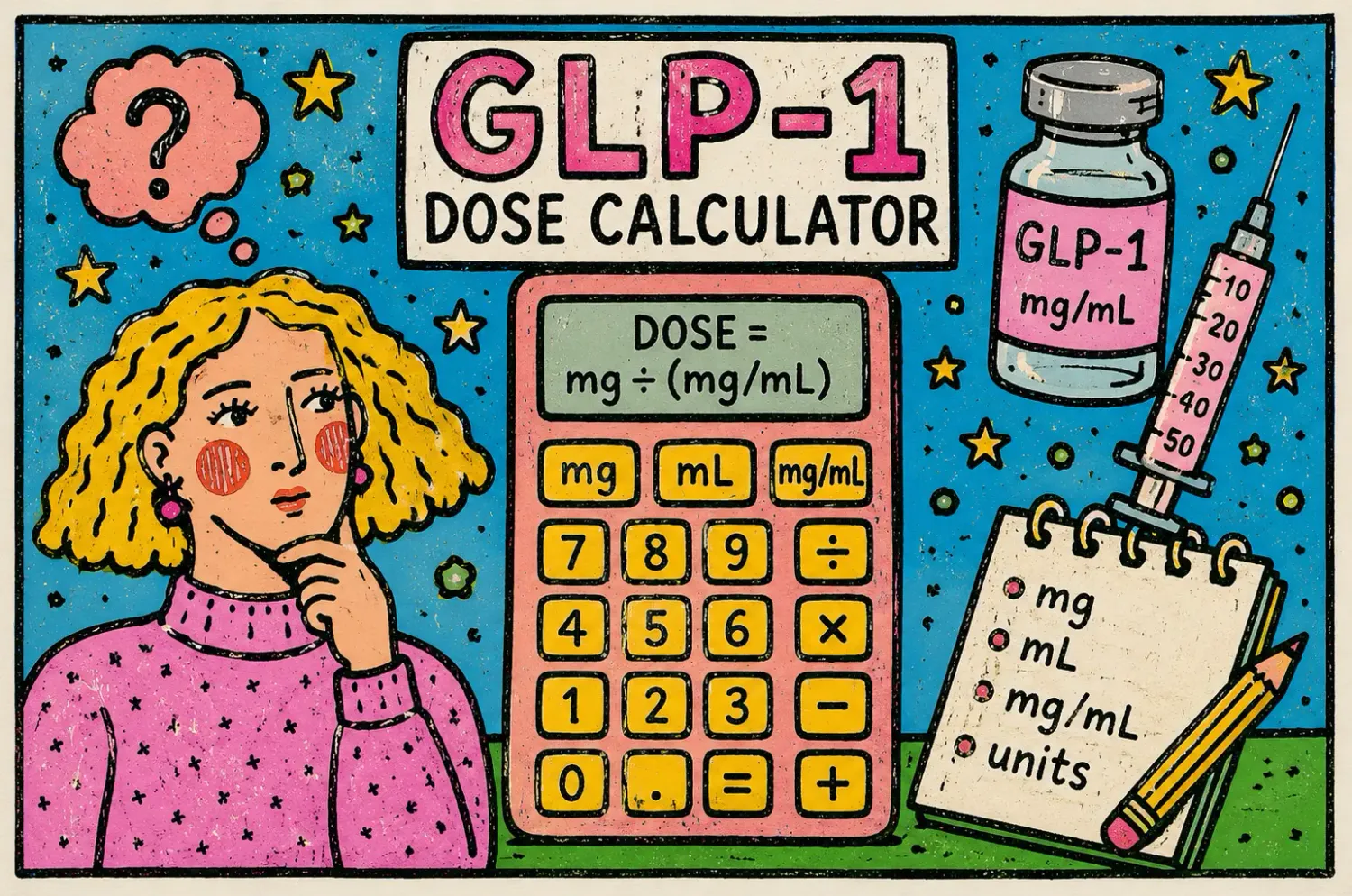
If you've ever looked at a GLP-1 medication label and wondered how mg, mL, concentration, and syringe units relate to one another, you're not alone.
The math itself can look simple. The medication context is not.
A GLP-1 dose calculator can help you understand the relationship between numbers, but it should never decide what dose you should take, change a prescribed dose, or replace the instructions supplied by your prescriber or pharmacist.
That distinction matters because different GLP-1 products can have different concentrations, formulations, delivery devices, approved uses, and dosing instructions.
Important: GLPIANS provides educational information, not individualized medical dosing. Do not use this page to start, stop, increase, decrease, split, or otherwise change a prescription medication. For the dose and administration instructions that apply to you, follow your prescription and current product instructions and contact your prescriber or pharmacist when anything is unclear.
Quick Answer: What Does a GLP-1 Dose Calculator Do?
A GLP-1 dose calculator can explain mathematical relationships among medication amount, liquid volume, and concentration when the necessary values are known.
It cannot determine the medically appropriate dose for an individual.
That decision depends on the medication, indication, formulation, treatment history, tolerability, prescribing information, and clinical judgment.
This is especially important when comparing:
- milligrams (mg)
- milliliters (mL)
- concentration (such as mg/mL)
- device-specific measurements
- different GLP-1 products
- compounded and FDA-approved medications
Those numbers describe different things. They should not be treated as interchangeable.
Why GLP-1 Dose Conversion Can Be Confusing
Most calculation confusion starts with one simple problem:
Dose and volume are not the same thing.
A medication's dose describes an amount of active drug.
A liquid volume describes how much liquid is present.
Concentration describes how much drug is contained within a specified amount of liquid.
That means two liquids can contain the same medication but have different concentrations.
If the concentration changes, the volume associated with a given amount of medication can change too.
This is why copying a number of “units” or a volume from another person's prescription, vial, online chart, Reddit comment, or calculator result can be unsafe.
The FDA has warned about exactly this type of confusion with compounded injectable semaglutide. Reports have involved confusion among milligrams, milliliters and syringe “units,” as well as products supplied in different concentrations. Some reported errors resulted in patients administering substantially more medication than intended and seeking medical care or hospitalization.
The four concepts to keep separate
| Term | What it describes | Why it matters |
|---|---|---|
| mg | Amount of drug | This is not automatically a liquid volume |
| mL | Volume of liquid | The same volume can contain different amounts of drug depending on concentration |
| mg/mL | Drug concentration | Needed when relating drug amount to liquid volume |
| Syringe/device markings | Measurement on a particular delivery device | They should not be assumed to equal a universal medication dose |
The key principle is simple:
A number has meaning only when you know what it measures.
Why “Units” Are Not Automatically a GLP-1 Dose
This is one of the most important concepts on this page.
Someone saying:
“I take 20 units.”
does not, by itself, tell you how many milligrams of medication they are receiving.
“Units” may describe markings on a particular syringe rather than the mass of the medication itself. Determining the drug amount also requires reliable information about the product and its concentration.
This is one reason online dose comparisons can become misleading.
The FDA has reported medication errors involving compounded semaglutide in which patients or healthcare professionals confused measurements and concentrations. In some reports, patients administered five to 20 times the intended amount.
A safer question to ask
Instead of asking:
“How many units should I take?”
ask:
“What exactly does my prescription label instruct me to administer, and how should I measure that using the product and device I was given?”
Your pharmacist or prescribing clinician can answer that question using your actual prescription.
GLP-1 Dose Conversion Is Not Universal
There is no single universal conversion table that safely converts every GLP-1 product.
Why?
Because several variables can change:
- the active ingredient;
- the formulation;
- the concentration;
- the delivery system;
- the labeled dose;
- the product instructions;
- whether the medication is FDA-approved or compounded.
This also means that semaglutide and tirzepatide doses should not be treated as equivalent numbers.
Semaglutide and tirzepatide are different active ingredients. Tirzepatide acts as both a GIP and GLP-1 receptor agonist, while semaglutide is a GLP-1 receptor agonist. Their milligram values therefore should not be interpreted as a direct potency conversion. Current product-specific prescribing information should be used for medication-specific guidance.
Semaglutide Is Not the Same Thing as Every Semaglutide Product
Another common source of confusion is treating an active ingredient and a brand name as interchangeable.
Semaglutide is an active ingredient.
Products containing semaglutide can have different approved indications, formulations and instructions.
Similarly:
Tirzepatide is an active ingredient.
Mounjaro and Zepbound contain tirzepatide, but product context and approved indications matter.
When using any GLP-1 calculator or reading an online dose chart, identify the actual medication and product before interpreting numbers.
FDA-Approved Products vs Compounded GLP-1 Products
This distinction matters substantially for dose-conversion questions.
FDA-approved medications undergo FDA review for safety, effectiveness and quality before approval.
Compounded medications are different. FDA states that compounded drugs do not undergo FDA premarket review for safety, effectiveness or quality and generally should be used when a patient's medical needs cannot be met by an available FDA-approved drug.
Compounded products can also create an additional calculation challenge because concentrations may vary.
FDA has specifically warned that compounded semaglutide products may be supplied in different concentrations and containers, creating opportunities for medication errors when converting between milligrams, milliliters and syringe measurements.
What this means for a calculator
A calculator should never silently assume that every vial has the same concentration.
And a user should never assume that a result based on someone else's vial applies to their own medication.
Why GLPIANS Does Not Tell You What Dose to Take
A mathematically valid calculation and a medically appropriate prescription are two different things.
A calculator can process numbers.
It cannot independently determine:
- whether a medication is appropriate for you;
- whether your prescribed dose should change;
- whether you should increase a dose;
- whether you should decrease a dose;
- whether you should change your injection schedule;
- whether you should switch products;
- whether a compounded formulation is appropriate;
- how your medical history changes a treatment decision.
Those are clinical questions.
The safest role for a GLP-1 calculation tool is therefore educational and verification-oriented, not prescriptive.
Before Using Any GLP-1 Dose Conversion Calculator
Use this quick verification framework.
1. Identify the exact medication
Do not begin with “my GLP-1.”
Identify the actual active ingredient and product.
2. Read the prescription label
The label supplied for your medication should be your primary reference for the prescribed amount and administration instructions.
3. Identify the measurement
Determine whether a number refers to:
- mg;
- mL;
- concentration;
- or a device measurement.
Never assume these are equivalent.
4. Verify the concentration when relevant
A volume calculation has no reliable medication meaning without the correct concentration.
5. Do not copy another person's calculation
A result from a friend, forum, social post, chart or another prescription may involve a different concentration or product.
6. Confirm anything unclear with a pharmacist or prescriber
This is particularly important before administering a medication.
A calculator can check arithmetic.
A pharmacist or clinician can verify that the instructions themselves are appropriate for your prescription.
The GLPIANS GLP-1 Shield & Dose Matrix™
GLPIANS developed the GLP-1 Shield & Dose Matrix™ as an educational utility designed to make several commonly confusing GLP-1 concepts easier to visualize and understand.
Rather than presenting GLP-1 information as a wall of numbers, the experience organizes different concepts into separate modules.
GlpPulse
GlpPulse provides an educational visualization of medication decline over time.
Semaglutide has an elimination half-life of approximately one week according to Wegovy prescribing information. Tirzepatide has an elimination half-life of approximately five days according to Zepbound prescribing information.
A half-life model can illustrate how mathematical decay works, but it cannot tell you your exact current blood concentration, predict exactly when hunger will return, or determine when another dose should be taken.
Individual pharmacokinetics and clinical experience are more complex than a simplified visualization.
DoseCraft
DoseCraft helps organize dose, volume and concentration concepts.
Its purpose should be understood as mathematical education, not prescription management.
Do not use a calculated result to independently alter a prescribed dose, split a prescription pen, determine an unprescribed dose, or prepare research peptides for human use.
If the numbers on your prescription, vial, syringe or device are confusing, verify them with the dispensing pharmacy or prescribing clinician before administration.
NoiseCancel
NoiseCancel focuses on the nutrition side of the GLP-1 experience.
Reduced appetite can make normal eating patterns harder for some people, so thinking intentionally about nutrition can become useful during treatment.
The module should be treated as an educational planning aid rather than a personalized medical nutrition prescription.
Individual protein and nutrition needs can vary based on factors including body size, activity, age, health status and clinical circumstances.
Save and Export
Where available, GLPIANS export features can make educational results easier to save or revisit.
Saved calculator information should not be treated as a prescription, medical record, or clinician-approved treatment protocol unless it has actually been reviewed by an appropriate healthcare professional.
What About a GLP-1 Dose Calculator for Weight Loss?
People often search for a GLP-1 dose calculator for weight loss expecting body weight to determine the correct medication dose.
That is not how a responsible calculator should work.
Do not enter your weight and expect an online tool to prescribe the appropriate amount of semaglutide, tirzepatide or another prescription GLP-1 medication.
Medication selection and dosing are clinical decisions.
Your prescribed regimen should come from an appropriately licensed healthcare professional and the applicable prescribing information—not an online weight-loss formula.
Can a Calculator Predict How Much GLP-1 Medication Is Still in Your Body?
Only in a simplified mathematical sense.
Drug half-life can be used to model exponential decline, which makes pharmacokinetic visualizations educationally useful.
For example, current prescribing information describes semaglutide's elimination half-life as approximately one week and tirzepatide's as approximately five days.
But a simplified decay model is not the same as measuring an individual's actual drug concentration.
Real pharmacokinetics can involve repeated dosing, absorption, distribution, accumulation, individual variation and other factors.
Therefore a calculator should not describe a modeled number as:
“the exact amount active in your body right now.”
A more accurate description is:
“an educational estimate generated from a simplified pharmacokinetic model.”
That distinction protects both accuracy and reader trust.
Can Falling Drug Levels Explain Midweek Hunger or “Food Noise”?
Not with the certainty implied by a simple countdown.
Medication exposure changes over time, but hunger and cravings are influenced by many factors.
A pharmacokinetic visualization can help explain the concept of drug elimination. It should not diagnose the cause of an individual's hunger or tell someone that a particular modeled concentration means their medication has “stopped working.”
If appetite changes are concerning or persistent, discuss them with the clinician managing your treatment rather than changing the medication schedule based on a graph.
Why Accurate GLP-1 Measurement Matters
Medication-measurement mistakes are not merely theoretical.
FDA has received reports of dosing errors involving compounded injectable semaglutide. Reported contributing factors included varying concentrations and confusion among milligrams, milliliters and “units.” Some reported patients required medical attention or hospitalization.
FDA has also warned about adverse events associated with compounded semaglutide or tirzepatide being prescribed beyond doses in FDA-approved labeling, including larger amounts, more frequent administration, or faster titration.
This is precisely why a responsible GLP-1 calculator should add context rather than simply produce a number.
The GLPIANS Three-Check Rule
Before relying on any medication-related calculation, use this simple GLPIANS educational framework:
CHECK 1 — Medication
What exact medication and formulation am I looking at?
CHECK 2 — Measurement
Does each number represent mg, mL, concentration, or something else?
CHECK 3 — Verification
Does the result agree with my actual prescription and the instructions from my pharmacist or prescriber?
If Check 3 is uncertain, stop there.
A calculator result is not a reason to guess.
Common GLP-1 Dose-Calculation Mistakes
Mistake 1: Treating mg and mL as interchangeable
They measure different things.
Mistake 2: Assuming “units” identifies the medication dose
It may not. Concentration and product information matter.
Mistake 3: Copying another user's calculation
Their formulation or concentration may be different.
Mistake 4: Treating semaglutide and tirzepatide milligrams as equivalent
They are different drugs and should not be converted through a homemade potency ratio.
Mistake 5: Assuming every compounded vial has the same concentration
FDA specifically notes that compounded products may have varying concentrations.
Mistake 6: Using a calculator to change a prescription
Arithmetic does not determine clinical appropriateness.
Mistake 7: Treating a pharmacokinetic estimate as a blood test
A modeled decay curve is an educational estimate, not a measurement of your serum concentration.
When to Stop Calculating and Ask a Professional
Contact your pharmacist or prescribing clinician when:
- the prescription label is unclear;
- you cannot identify the concentration;
- the medication instructions and calculator result disagree;
- you received a different concentration than expected;
- you are changing formulations or products;
- you are uncertain how to use the supplied delivery device;
- you believe you may have administered the wrong amount;
- you are considering changing your prescribed dose or schedule.
If you believe you have taken too much medication or are experiencing severe or concerning symptoms, seek appropriate medical care rather than relying on an online calculator.
The Bottom Line
A GLP-1 dose calculator is most useful when it makes medication mathematics easier to understand—not when it attempts to practice medicine.
Remember the fundamental relationship:
Dose, volume, concentration, and device measurements describe different things.
That becomes particularly important with products whose concentrations or delivery systems differ.
Use GLPIANS tools to understand the concepts and visualize the math.
Use your prescription, current product instructions, pharmacist, and prescribing clinician to determine what you should actually administer.
That's the boundary between useful calculation and safe medication management.
Explore the GLPIANS GLP-1 Shield & Dose Matrix™
Use the free educational tools to explore GLP-1 concepts, visualize pharmacokinetic models, and better understand the numbers you encounter during your GLP-1 journey.
No calculator should override your prescription. If a result conflicts with your medication instructions, stop and verify it with your pharmacist or prescriber.
D. FAQ
Is there a GLP-1 dose calculator?
Yes, calculators can help explain relationships among medication amount, volume and concentration. However, an online calculator should not determine the medically appropriate prescription dose for an individual.
How do you calculate a GLP-1 dose?
Medication mathematics can involve dose, concentration and liquid volume, but determining what dose a person should take is a clinical decision. Follow the prescription and product-specific instructions rather than using a generic online formula to select a dose.
Are mg and units the same?
No. Milligrams describe an amount of drug, while syringe “units” can represent a volume measurement on a particular syringe. The amount of medication represented by a volume depends on the concentration. FDA has identified confusion between mg, mL and units as a contributor to dosing errors with compounded injectable semaglutide. (U.S. Food and Drug Administration)
Can I convert semaglutide mg to tirzepatide mg?
There is no simple universal milligram-for-milligram conversion that should be used to switch between them. They are different medications with different pharmacology and product-specific dosing instructions. (FDA Access Data)
Can a GLP-1 dose calculator tell me how much to take for weight loss?
It should not. Your body weight alone should not be used by an online calculator to prescribe a personalized dose. Medication selection and dosing should follow the applicable prescription and clinical guidance.
Can I calculate how much GLP-1 medication is still active in my body?
Half-life data can produce a simplified mathematical estimate of drug decline. It cannot measure the exact amount currently circulating in an individual person's body. Wegovy labeling reports an approximately one-week elimination half-life for semaglutide, while Zepbound labeling reports an approximately five-day elimination half-life for tirzepatide. (FDA Access Data)
Why can compounded GLP-1 dose calculations be confusing?
Concentrations can vary, and users may encounter several measurements including mg, mL and syringe units. FDA has reported dosing errors associated with this type of confusion. (U.S. Food and Drug Administration)
E. REFERENCES / SOURCES
The primary evidence base used here was FDA safety information and FDA-approved/current product labeling.
FDA — Dosing Errors Associated With Compounded Injectable Semaglutide
FDA — Concerns With Unapproved GLP-1 Drugs Used for Weight Loss
FDA — Wegovy Prescribing Information