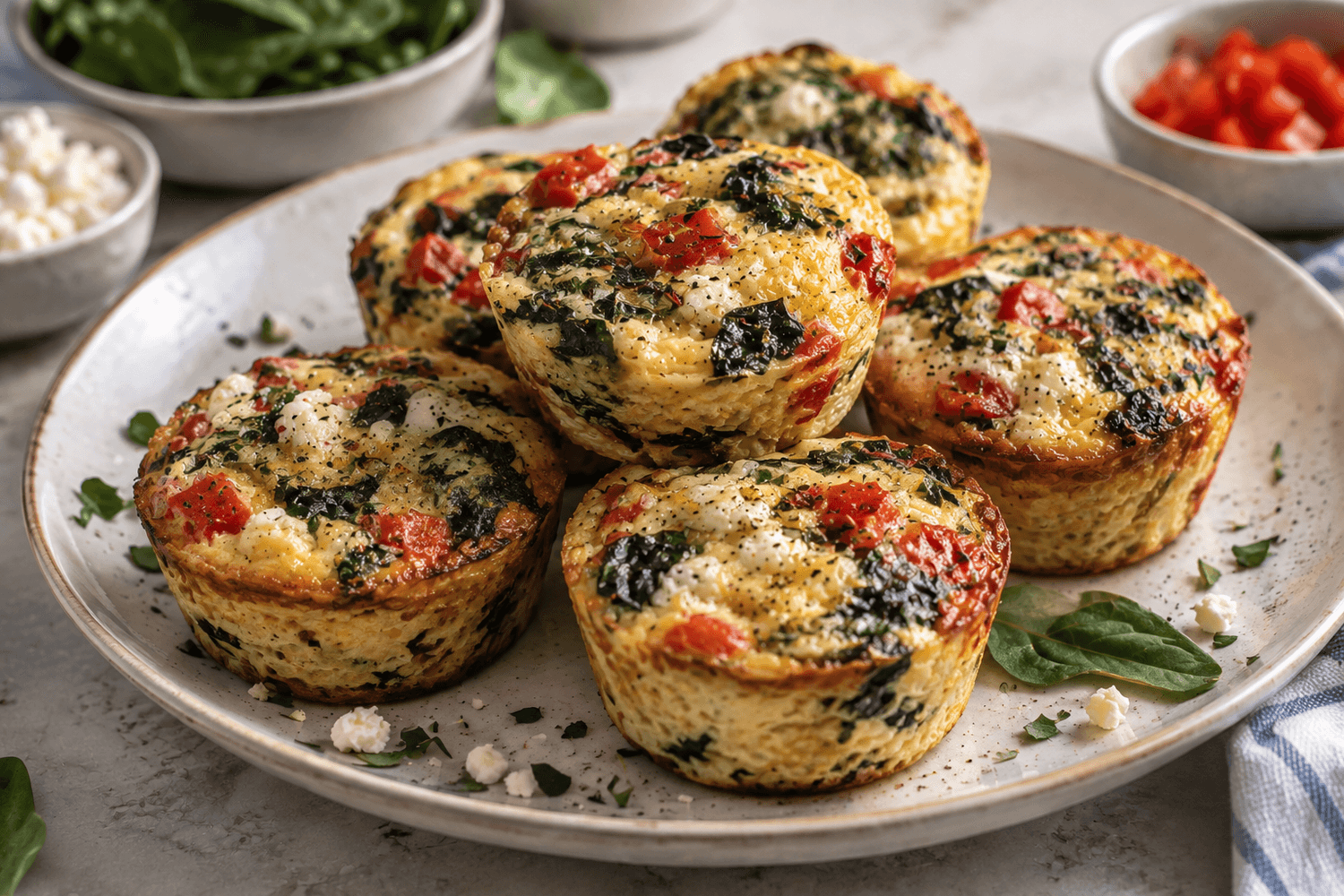



Starbucks-Style Cottage Cheese Egg Bites for Small-Volume Breakfast Meal Prep
These cottage cheese egg bites turn 8 large eggs and 1 cup of low-fat cottage cheese into 12 small, tender breakfast bites with spinach, roasted red pepper, feta, oregano, and black pepper.
The cottage cheese is blended directly into the eggs rather than left as visible curds. That creates a smoother mixture and gives the finished egg bites a softer, custard-like texture.
The batch makes 12 egg bites, or 6 servings of 2 egg bites each. You can cook them in the oven or air fryer, refrigerate them for up to four days, and reheat individual portions when needed.
For context, Starbucks' current Egg White & Roasted Red Pepper Egg Bites also use cottage cheese, spinach, roasted red pepper and feta and are described as having a velvety texture. This GLPIANS recipe is Starbucks-style rather than an official Starbucks recipe and uses a home-friendly blended whole-egg preparation instead of claiming to reproduce the company's sous-vide process. (Starbucks)
Why Blend Cottage Cheese Into Egg Bites?
The most important technique in this recipe happens before the egg mixture reaches the oven or air fryer.
Blending cottage cheese with the eggs distributes the dairy throughout the mixture instead of leaving large curds scattered through the finished bites. The result is a smoother base that pairs naturally with finely chopped vegetables and feta.
It also makes the recipe easy to portion. Instead of preparing one large breakfast casserole and cutting it into uncertain pieces, the 12-cup mold creates individual portions from the start.
That matters for meal prep because 2 egg bites is a defined serving, while the entire batch remains ready in the refrigerator.
Why These Egg Bites Work for GLP-1 Meal Prep
There is no special medical property that makes an egg bite inherently "GLP-1 friendly." The practical advantage is portion design.
For people using GLP-1 medications who prefer smaller meals, two egg bites provide a compact breakfast portion that can be eaten on its own or combined with a small side.
Individual tolerance also varies. Some people may prefer a smaller amount of food at one sitting, while others may want additional food alongside the egg bites. This recipe is designed to make that adjustment simple without requiring a separate breakfast preparation.
The recipe is also useful for people who simply want a make-ahead breakfast and do not use GLP-1 medication.
For a broader collection of protein-focused breakfast ideas, see GLPIANS' high-protein Greek yogurt parfait meal-prep breakfast.
What Makes These Egg Bites Different From Standard Egg Muffins?
The difference is primarily in the preparation method.
Traditional egg muffins often combine beaten eggs, vegetables, and cheese directly in a muffin tin. That approach can work, but large vegetable pieces and uneven moisture can create a firmer, more irregular texture.
This recipe takes a different approach:
- The eggs and cottage cheese are blended together.
- The spinach is cooked and squeezed dry.
- The roasted pepper is drained and patted dry.
- The vegetables are finely chopped.
- The filling is divided before the blended egg mixture is added.
- The egg bites are cooked only until the centers reach 160°F.
Those details are more important than adding a long list of "healthy" ingredients.
Ingredients That Matter Most
Low-Fat Cottage Cheese
Choose a Low-Fat Cottage Cheese with a relatively high protein content. Brand nutrition varies, so the nutrition information on your specific container should take priority when you need exact tracking.
The cottage cheese is not simply a protein add-in. It is part of the texture system.
Eggs
The recipe uses whole eggs rather than attempting to turn this into an egg-white-only recipe. Whole eggs provide the structure and richness needed for the intended custard-like bite.
Spinach
Cook the spinach first and squeeze out excess water.
This is a small step with a large effect. Raw or poorly drained spinach can release water into the egg mixture while it cooks, producing a wetter finished texture.
Roasted Red Pepper
Roasted red pepper provides sweetness, color, and vegetable flavor without requiring a large quantity.
Drain it well before chopping.
Feta
A small amount of feta provides a concentrated salty, tangy flavor. Because the recipe uses only 2 tablespoons, it contributes flavor without turning the egg bites into a heavily cheese-loaded breakfast.
Oven Method vs. Air Fryer Method
Oven
The oven method uses 350°F and a shallow water pan on a lower rack.
The water is not intended to touch the egg bites. It simply creates a more humid oven environment while the custard cooks.
Bake for approximately 20–22 minutes, then verify that the center reaches 160°F.
Air Fryer
The air-fryer method uses a lower temperature of approximately 325°F and a shorter cooking window of roughly 10–14 minutes.
Do not automatically transfer the oven's water-pan technique to an air fryer. Air-fryer designs differ, and loose water in an appliance basket is not appropriate for every model.
Instead, use an air-fryer-safe silicone mold, keep the temperature moderate, and begin checking early.
The exact time will vary with the air fryer, mold, fill level, and basket configuration.
How to Prevent Watery Egg Bites
Three things matter most:
1. Squeeze the spinach.
Cooked spinach holds considerable water. Remove as much excess moisture as practical.
2. Dry the roasted peppers.
Drain them and pat them dry before chopping.
3. Do not overfill the mold.
Keep the cups approximately three-quarters full so the egg mixture can cook evenly.
If the finished egg bites are watery, the problem is more likely to be excess vegetable moisture or undercooking than a need for another thickening ingredient.
How to Reheat Egg Bites Without Making Them Rubbery
The key is to reheat gently rather than repeatedly blasting them at full power.
For two refrigerated egg bites, start with approximately 20–30 seconds at medium microwave power. Check the center and add short increments only when necessary.
A microwave-safe cover or damp paper towel helps limit surface drying.
If the egg bites are being reheated from refrigerated storage, food safety still matters: FDA guidance recommends reheating refrigerated cooked egg dishes to 165°F before serving. (U.S. Food and Drug Administration)
The short reheating interval is therefore a practical starting point, not a food-safety temperature guarantee. Microwave power and starting temperature vary.
How Long Do Cottage Cheese Egg Bites Last?
Keep cooked egg bites refrigerated at 40°F or below and use them within 3–4 days.
That four-day window is consistent with federal guidance for refrigerated cooked egg dishes. (U.S. Food and Drug Administration)
For the best meal-prep texture, store them in a sealed container after they have cooled sufficiently and avoid trapping unnecessary condensation.
If you know you will not eat the batch within the recommended refrigerated window, prepare a smaller batch rather than treating the four-day period as an invitation to stretch storage longer.
A Simple Two-Bite Breakfast Routine
The easiest way to use this recipe is to leave the serving structure intact.
One batch = 12 egg bites.
One serving = 2 egg bites.
That gives you 6 prepared breakfast portions.
On a busy morning, take one two-bite portion from the refrigerator, reheat it gently, and add fruit, yogurt, toast, or another small accompaniment if desired.
This structure also makes it easier to stop at a smaller portion without having to measure food from a larger casserole.
When This Recipe Is a Good Fit
These egg bites are particularly useful when you want:
- a make-ahead breakfast;
- a small portion rather than a large breakfast plate;
- a protein-containing breakfast;
- an oven or air-fryer option;
- a breakfast that can be eaten at home or packed for work;
- a recipe that uses cottage cheese without leaving large curds;
- individually portioned meal prep.
They are not a treatment for nausea, reflux, delayed gastric emptying, or any other medical condition. If particular foods do not agree with you while taking a GLP-1 medication, individual tolerance matters more than a recipe label.
Evidence-Based Food Safety Matters More Than the Meal-Prep Shortcut
Egg dishes are perishable foods and should be handled accordingly.
The FDA advises cooking egg dishes to 160°F, refrigerating leftover cooked egg dishes, using them within 3–4 days, and reheating cooked egg dishes to 165°F before serving. (U.S. Food and Drug Administration)
That is why this recipe does not promise that a particular microwave time will make every portion safe. The microwave timing is only a practical starting point; a thermometer provides the meaningful temperature check.