


Dump and Bake Chicken Thigh Cauliflower Rice Bake | GLP-1 Dinner

4.9 ★
0 people reviewed 🎉 Thanks for review!
Lauren Hayes
Written By Lauren Hayes ✓
Lauren Hayes
Recipe Developer & Culinary Editor

Lauren develops and reviews GLPIANS recipes with a focus on ingredient accuracy, cooking technique, texture, timing, portioning, and reliable home-kitchen execution.

Melissa Grant, MS, RDN
Reviewed By Melissa Grant, MS, RDN ✓
Melissa Grant, MS, RDN
Registered Dietitian Nutritionist

Melissa reviews GLPIANS content for nutrition accuracy, responsible GLP-1 framing, portion guidance, and evidence-based communication.

Daniel Harper, MPH
Fact Checked By Daniel Harper, MPH ✓
Daniel Harper, MPH
Food Safety & Health Fact Checker

Daniel reviews GLPIANS content for food-safety accuracy, including cooking temperatures, food handling, storage, reheating, and source-backed safety guidance.

A True Dump-and-Bake Chicken Dinner for Low-Energy Nights

This dump-and-bake chicken thigh and cauliflower rice bake puts raw chicken, uncooked white rice, frozen cauliflower rice, frozen vegetables, and seasoned chicken broth into one covered baking dish. There is no separate rice pot and no chicken-searing step.

The result is a practical chicken-and-rice casserole designed around minimal active cooking.

The important part is that this is not simply a standard chicken casserole with cauliflower rice added. The rice starts uncooked, the cauliflower rice starts frozen, and both interact with the broth during baking. The covered cooking method is therefore part of the recipe rather than an optional step.
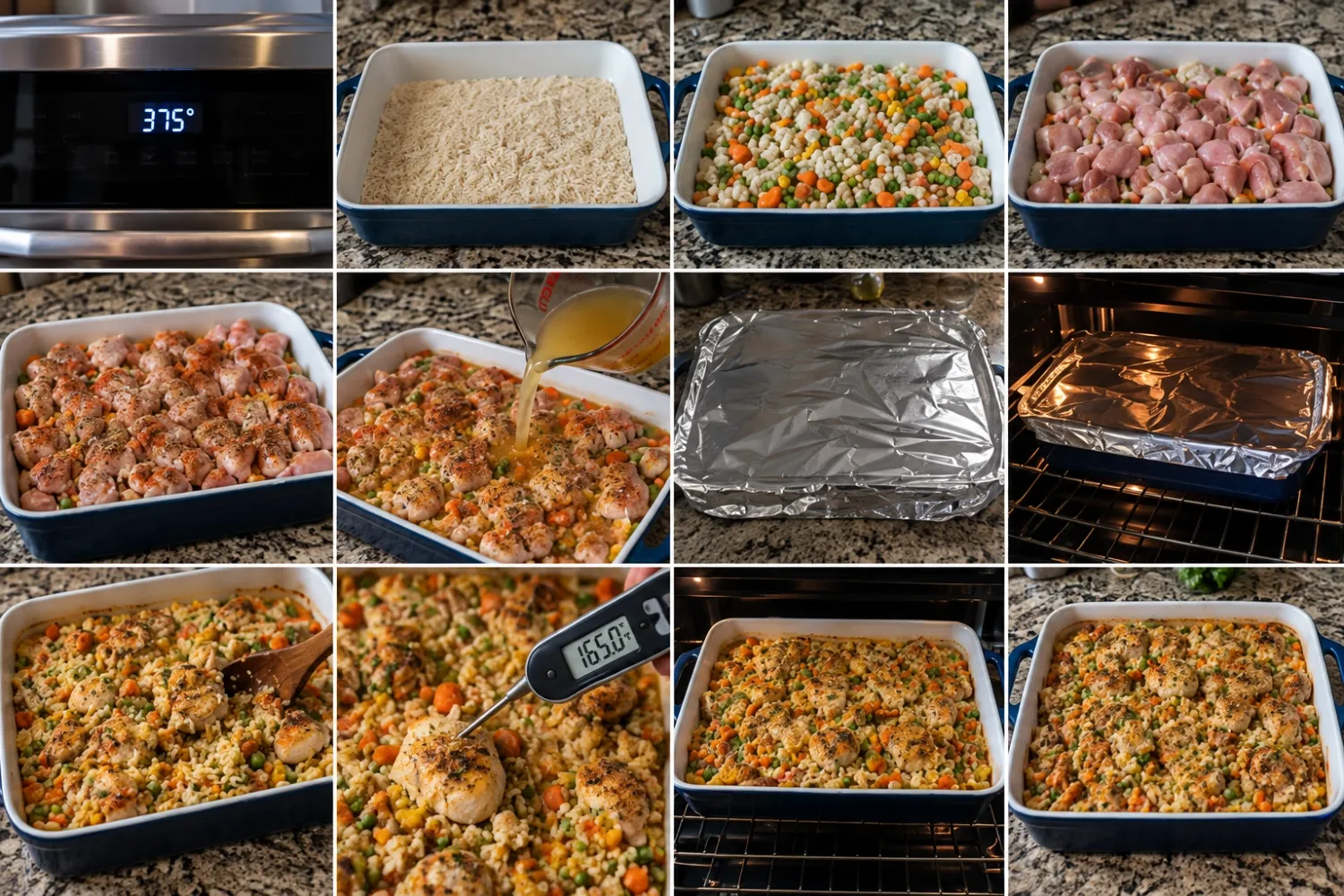
Step by step process of making dump and bake chicken thigh cauliflower rice bake in one dish

Why This Recipe Works for a Low-Effort Dinner

The biggest advantage is the workflow.

You do not need to:

  • brown the chicken first;
  • cook the rice separately;
  • thaw the vegetables;
  • sauté vegetables in another pan;
  • transfer ingredients between cookware.

Everything goes into one baking dish before it enters the oven.

That makes the recipe especially practical when the goal is to reduce active cooking rather than maximize culinary technique.

Why Chicken Thighs Are Used Instead of Chicken Breast

Chicken thighs are a useful choice for this particular cooking method because they contain more fat than chicken breast and are generally more forgiving during a longer casserole bake.

That does not mean chicken thighs are medically preferable for people taking GLP-1 medications. The reason is culinary: this recipe needs a protein that can remain reasonably tender while the rice finishes cooking.

Chicken breast can still be used, but it requires closer attention to cooking time and should be checked earlier with a food thermometer.

The White Rice and Cauliflower Rice Balance

The recipe uses 1 cup of uncooked long-grain white rice and 3 cups of frozen cauliflower rice.

That distinction matters.

Uncooked white rice needs liquid to hydrate and soften. Frozen cauliflower rice behaves differently and releases moisture as it cooks.

For that reason, you should not simply replace the white rice with an equal volume of cauliflower rice or assume that adding more cauliflower rice requires proportionally more broth.

The recipe's liquid amount is designed around the specific combination of uncooked white rice and frozen cauliflower rice.

How to Prevent a Chicken-and-Rice Bake From Drying Out

Three details are particularly important:

1. Keep the casserole tightly covered

The foil traps steam during the main cooking stage. That steam helps the rice cook and limits moisture loss.

2. Use the specified rice

Regular long-grain white rice is the intended rice for this formula. Instant rice and brown rice behave differently and should not be substituted without changing the recipe.

3. Avoid unnecessary oven-door and foil opening

Opening the casserole repeatedly releases steam. Keep it covered through the primary 40-minute cooking stage and only uncover it for the final check and finishing period.

Can You Use 100% Cauliflower Rice?

Not as a direct substitution.

The uncooked white rice provides starch and absorbs broth as it cooks. Cauliflower rice does not behave the same way; it releases moisture and has a different structure after cooking.

A completely cauliflower-rice version would therefore require its own recipe formulation rather than simply removing the white rice.

For the most predictable result, use the stated combination.

Why This Can Fit a GLP-1 Meal-Planning Routine

The useful GLP-1 connection here is practicality, not a special effect from any individual ingredient.

A person taking a GLP-1 medication may prefer meals that are easier to portion, require little active preparation, and can be stored for later meals. Individual appetite and food tolerance vary, so the appropriate portion is not necessarily the full recipe-card serving.

This casserole provides chicken, rice, cauliflower rice, and mixed vegetables in one dish, making it possible to portion the meal according to individual appetite.

It is also family-friendly: one person can take a smaller portion while another person can take more without requiring separate meals.

For broader nutrition information during GLP-1 treatment, readers should rely on individualized advice from an appropriate healthcare professional or dietitian rather than treating any single recipe as a medical diet.

Why the Covered Baking Method Matters

The covered stage is not just a convenience.

The casserole contains uncooked rice, which needs sufficient moisture and heat to become tender. The foil helps retain steam while the broth heats and the frozen vegetables release additional moisture.

Removing the cover too early can increase moisture loss and make the rice less reliable.

After the rice has cooked, the casserole gets a short uncovered finish. This helps the surface settle and prevents the finished dish from remaining excessively wet.

Can You Use Chicken Breast?

Yes, but it is not the preferred version for this specific formula.

If using chicken breast:

  • cut it into approximately 1-inch pieces;
  • distribute the pieces evenly;
  • start checking the temperature earlier;
  • avoid overcooking;
  • confirm that the chicken reaches 165°F.

USDA recommends 165°F as the safe minimum internal temperature for poultry, measured with a food thermometer. (Ask USDA)

A Practical Family Dinner Without Separate Meals

One of the useful features of this casserole is serving flexibility.

The same dish can work for a family without requiring a separate "GLP-1 meal."

Someone with a larger appetite can take more and add a side salad or vegetables. Someone who wants a smaller meal can start with less.

That flexibility is more useful than assigning one rigid serving size to every person.

What Makes This Different From a Standard Chicken Casserole?

Many chicken-and-rice casseroles require some combination of:

  • pre-cooking rice;
  • browning chicken;
  • sautéing vegetables;
  • using multiple pans;
  • assembling several separately cooked components.

This recipe intentionally removes those active stages.

The trade-off is that the ingredient combination has to remain specific. The rice type, frozen cauliflower rice, broth amount, foil seal, and cooking temperature all work together.

That is why substitutions such as brown rice or 100% cauliflower rice should not be treated as automatic swaps.

More GLPIANS Recipes for Different Low-Effort Dinner Formats

If you want another chicken dinner but prefer a stovetop method, try the Creamy Garlic Chicken Skillet.

If you want a different rice-based protein meal, the Honey Garlic Salmon Rice Bowl uses a bowl format rather than a baked casserole.

For another batch-friendly low-active-prep dinner, the Slow Cooker Turkey Black Bean Chili takes a slow-cooker approach.

Food-Safety Reminder

The chicken in this casserole starts raw, so the final temperature matters more than visual appearance.

Use an instant-read thermometer and verify that the chicken reaches 165°F. USDA specifically recommends a food thermometer because appearance alone is not a reliable way to establish poultry safety. (Ask USDA)

Refrigerate leftovers promptly and use them within the recommended refrigerated storage window. (Ask USDA)
GLPIANS
Professional Recipe Collection
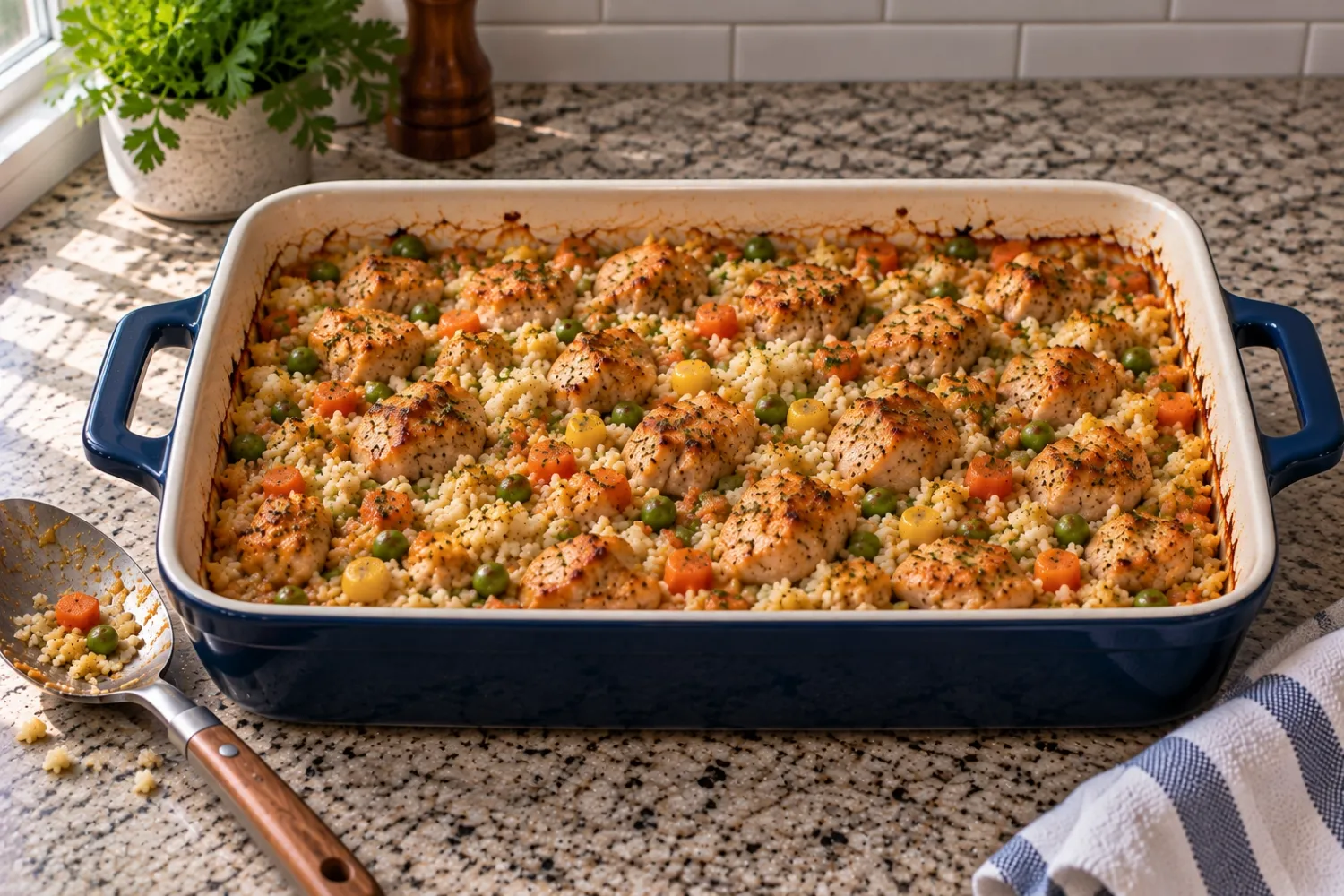
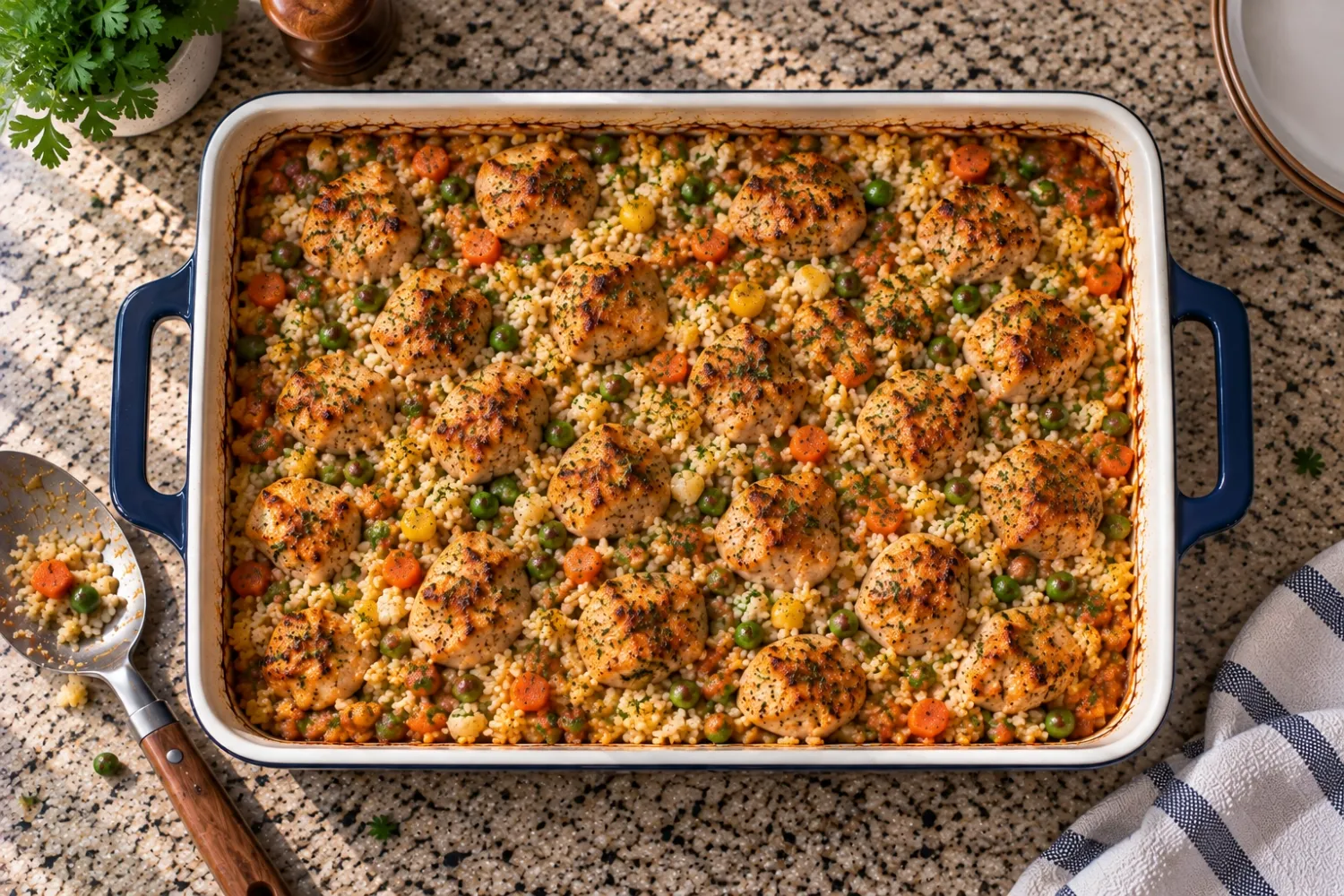
Dump-and-bake chicken thighs with white rice, cauliflower rice, and mixed vegetables in a casserole dish
ONE-PAN DUMP-AND-BAKE CASSEROLE

Dump-and-Bake Chicken Thigh & Cauliflower Rice Bake

A hands-off one-dish dinner made with boneless chicken thighs, uncooked long-grain white rice, frozen cauliflower rice, frozen mixed vegetables, and seasoned chicken broth. The casserole bakes covered so the rice cooks in the broth while the chicken stays moist.

Servings
6
Yield 6 servings
Prep Time 10 mins
Cook Time 50 mins
Total Time 1 hr
Course Dinner
Cuisine American

Ingredients

Equipment

9-by-13-inch baking dish
Aluminum foil
Measuring cups and spoons
Cutting board
Chef's knife
Instant-read food thermometer
Large spoon or spatula

Instructions

  • 1
    Preheat the oven to 375°F. Lightly grease a 9-by-13-inch baking dish.
  • 2
    Build the rice layer. Spread the uncooked long-grain white rice evenly across the bottom of the baking dish.
  • 3
    Add the vegetables. Scatter the frozen cauliflower rice and frozen mixed vegetables evenly over the rice. Do not thaw them first.
  • 4
    Add the chicken. Arrange the diced chicken thighs evenly over the vegetables and rice.
  • 5
    Season. Drizzle the olive oil over the chicken and vegetables. Sprinkle the garlic powder, onion powder, smoked paprika, kosher salt, and black pepper evenly over the dish.
  • 6
    Add the broth. Pour the chicken broth evenly around the casserole. Gently press the rice and vegetables down so the rice is substantially exposed to the liquid. Do not vigorously mix the raw chicken throughout the casserole.
  • 7
    Cover tightly. Cover the entire baking dish tightly with aluminum foil. The tight seal is important because trapped steam helps cook the rice.
  • 8
    Bake covered for 40 minutes.
  • 9
    Check the casserole. Carefully remove the foil, avoiding the escaping steam. Gently stir the rice and vegetables from the bottom upward. Check the thickest chicken pieces with an instant-read thermometer.
  • 10
    Finish baking. Finish baking uncovered for 8 to 10 minutes, or until the rice is tender and every chicken piece reaches at least 165°F internally.
  • 11
    Rest for 5 minutes. Remove the casserole from the oven and let it stand uncovered for 5 minutes.
  • 12
    Serve. Gently fluff the rice mixture and divide into 6 portions.

Recipe Notes

  • The foil is essential. The covered stage traps steam needed to cook the uncooked rice.
  • Use long-grain white rice. Instant rice, quick-cooking rice, brown rice, and wild rice have different liquid and cooking requirements.
  • Keep the cauliflower rice frozen. Its moisture is part of the recipe's cooking environment.
  • Cut the chicken evenly. Approximately 1-inch pieces help the chicken cook at a similar rate.
  • Do not repeatedly open the foil. Excess steam loss can interfere with rice cooking.
  • Use a thermometer rather than appearance to judge chicken safety.
  • If the rice remains firm after the covered stage, cover the dish again and continue baking in short increments until tender. If the casserole appears unusually dry, add a small splash of hot broth before continuing.
  • The final casserole should be moist and cohesive, not watery.

Nutrition Facts

Estimated nutrition per serving (approx. 1/6 of casserole):
NutrientAmount
Calories~440 kcal
Protein~32 g
Carbohydrates~39 g
NutrientAmount
Fat~18 g
Fiber~5 g
Sugar~4 g
NutrientAmount
Sodium~500 mg

Substitutions

  • Chicken thighs: Chicken breast (Not completely equivalent. Monitor closely for dryness).
  • Frozen mixed vegetables: Comparable amount of frozen peas, carrots, corn, or a simple combination.
  • Low-sodium chicken broth: Regular chicken broth (Sodium will increase; adjust added salt).
  • Olive oil: Avocado oil or another neutral cooking oil.
  • Long-grain white rice: Not recommended to substitute brown, wild, or instant rice.

Storage

Transfer leftovers to shallow airtight containers and refrigerate promptly. Keep refrigerated leftovers for 3 to 4 days. For longer storage, freeze individual portions.

Reheating

Microwave: Cover loosely. Heat until steaming hot throughout, stirring once. Add a splash of broth if dry.
Oven: Cover oven-safe dish with a splash of broth/water. Reheat at 350°F to 165°F internally.

Make-Ahead / Meal Prep

  • Best approach: cook first, portion second.
  • Bake the complete casserole first and allow the food to cool appropriately in shallow containers.
  • Divide the cooked food into portions.
  • Refrigerate portions intended for the next 3 to 4 days.
  • Freeze additional portions for longer storage.

Serving Suggestions

Keep the dinner simple and practical with these serving touches:

  • Serve the casserole as a complete one-dish dinner.
  • Add chopped parsley or sliced green onions for a fresh finishing touch if desired.
  • Pair a larger family portion with a simple green salad or additional vegetables.
  • For a smaller appetite, start with a smaller portion and add more only if desired.
  • The casserole can be served directly from the baking dish for a simple family-style dinner.
Serving Suggestions for Dump-and-Bake Chicken Thigh Casserole

GLP-1 Practical Notes

This recipe is designed around a practical need: less active cooking effort.

It should not be presented as a treatment, medication-support food, or guaranteed weight-loss meal.

For readers whose appetite is smaller, a smaller portion may be more comfortable. Individual tolerance varies, and people who have ongoing difficulty meeting their nutritional needs while taking a GLP-1 medication should discuss their situation with their healthcare professional or a qualified dietitian.

Common Mistakes to Avoid

Using instant rice

Instant rice does not have the same cooking requirements as regular uncooked long-grain white rice.

Replacing the white rice with cauliflower rice

That changes the recipe's starch, moisture, and cooking behavior. It is not a direct substitution.

Leaving the casserole uncovered

The covered stage is important for retaining the steam needed to cook the rice.

Thawing and squeezing the cauliflower rice

The recipe is designed around frozen cauliflower rice and its moisture contribution.

Opening the foil repeatedly

Steam loss can make the rice less predictable.

Judging chicken by appearance

Chicken should be checked with a food thermometer and cooked to 165°F. (Ask USDA)

Storage and Reheating Reminder

For best results, portion the cooked casserole after baking rather than repeatedly reheating the entire dish.

Refrigerated leftovers should be used within 3 to 4 days. (Ask USDA)

When reheating, add a small splash of broth or water if the rice has dried out and heat the portion thoroughly.

Optional GLPIANS Next Step

If you want to assess your broader GLP-1 nutrition and meal-planning habits, the GLPIANS Free GLP-1 Success Audit is an optional resource.

It is not required to prepare this recipe and does not replace individualized medical or nutrition advice.

Frequently Asked Questions

How do you prevent a chicken rice bake from drying out?

Keep the casserole tightly covered during the main baking stage, use the specified amount of broth, avoid opening the foil repeatedly, and use chicken thighs for a more forgiving texture.

Why choose chicken thighs over chicken breasts for this recipe?

Chicken thighs are generally more forgiving in a longer casserole bake because they contain more fat than chicken breast. Chicken breast can be used, but it should be monitored more closely to avoid overcooking.

Can you use 100% cauliflower rice?

Not as a direct substitution. The uncooked white rice absorbs broth and contributes starch and structure, while cauliflower rice releases moisture and cooks differently.

Can you use frozen cauliflower rice?

Yes. Use it directly from frozen. The recipe is designed around the additional moisture released as the cauliflower rice cooks.

Do you cook the chicken before adding it?

No. The chicken is added raw and cooks in the covered casserole. It must reach 165°F internally before serving. (Ask USDA)

Can you use brown rice?

Not without reformulating the recipe. Brown rice requires different cooking and liquid conditions.

Can you use chicken breast?

Yes. Cut it into approximately 1-inch pieces and check the temperature earlier than you would for the thigh version. Cook to 165°F.

How long does the casserole last in the refrigerator?

Use refrigerated leftovers within 3 to 4 days when they have been handled and stored safely. (Ask USDA)

Is this specifically a GLP-1 diet recipe?

It is designed around practical considerations that may be useful to some people taking GLP-1 medications, including low active cooking effort and flexible portions. It is not a medical treatment or a medication-specific diet.

Can I freeze the leftovers?

Yes. Portioning the cooked casserole before freezing makes later reheating more convenient.

Your Next GLPIANS Step

Use the free audit as a starting point for reviewing your broader GLP-1 nutrition and meal-planning habits. It is optional and does not replace individualized professional advice.

Explore the Free GLP-1 Success Audit
Link copied to clipboard!