



Creamy Garlic Chicken Skillet | High-Protein GLP-1 Dinner

4.9 ★
0 people reviewed 🎉 Thanks for review!
Lauren Hayes
Written By Lauren Hayes ✓
Lauren Hayes
Recipe Developer & Culinary Editor

Lauren develops and reviews GLPIANS recipes with a focus on ingredient accuracy, cooking technique, texture, timing, portioning, and reliable home-kitchen execution.

Melissa Grant, MS, RDN
Reviewed By Melissa Grant, MS, RDN ✓
Melissa Grant, MS, RDN
Registered Dietitian Nutritionist

Melissa reviews GLPIANS content for nutrition accuracy, responsible GLP-1 framing, portion guidance, and evidence-based communication.

Daniel Harper, MPH
Fact Checked By Daniel Harper, MPH ✓
Daniel Harper, MPH
Food Safety & Health Fact Checker

Daniel reviews GLPIANS content for food-safety accuracy, including cooking temperatures, food handling, storage, reheating, and source-backed safety guidance.

A Creamy Garlic Chicken Skillet for a Family-Friendly GLP-1 Dinner

This GLP-1 chicken skillet recipe combines thin chicken breast cutlets, garlic, baby spinach, light cream cheese, plain nonfat Greek yogurt, Parmesan, and chicken broth in one skillet.

The result is a creamy, protein-forward dinner without relying on heavy cream. The recipe makes 4 servings and provides approximately 36 grams of protein per serving based on the final ingredient quantities.

The practical advantage is flexibility: the same chicken skillet can be served to the whole family, while individual portions and side dishes can be adjusted according to appetite and preference.

Why This Creamy Chicken Skillet Works for Family Dinner

A family dinner becomes easier when the main dish does not require separate versions for different people.

This skillet provides a familiar combination of chicken, garlic, Parmesan, spinach, and creamy sauce. Someone wanting a smaller meal can serve the chicken with its sauce and a vegetable, while another family member can add rice, pasta, potatoes, or bread.

That makes the recipe useful as a shared dinner rather than a separate "diet meal."

The chicken also supplies a concentrated source of protein in a relatively compact portion, which fits the recipe's practical GLP-1 positioning without claiming that the food itself changes medication effects.

What Makes the Sauce Different

Traditional creamy chicken recipes often rely heavily on heavy cream, butter, or larger amounts of full-fat dairy.

This version builds its sauce from four components:

  • Chicken broth for liquid and savory flavor
  • Light cream cheese for body
  • Plain nonfat Greek yogurt for creaminess
  • Parmesan for concentrated savory flavor

The important technique is temperature control.

Greek yogurt should not be added directly to a violently bubbling skillet. Instead, a few tablespoons of the warm broth mixture are whisked into the yogurt first. The tempered yogurt is then returned to the skillet over low heat.

This gradual approach helps the yogurt incorporate more smoothly into the sauce.

How to Keep Greek Yogurt Smooth in a Cream Sauce

The basic process is simple:

  1. Cook the chicken and remove it from the skillet.
  2. Lower the heat before making the sauce.
  3. Whisk broth and softened light cream cheese together.
  4. Briefly remove the skillet from the heat.
  5. Temper the Greek yogurt with a few tablespoons of the warm broth mixture.
  6. Return the yogurt mixture to the skillet over low heat.
  7. Add Parmesan and spinach without bringing the sauce to a vigorous boil.

If the sauce becomes too thick, add a small amount of chicken broth.

The goal is not to cook the sauce harder. The goal is to maintain a gentle temperature while the dairy ingredients come together.

Why Thin Chicken Cutlets Are the Right Choice

Thin chicken breast cutlets are particularly useful for this skillet because they cook quickly and can be browned before being returned to the sauce.

The exact cooking time depends on thickness, skillet temperature, and the individual pieces, so the recipe uses an internal temperature rather than appearance as the final safety test.

USDA guidance recommends 165°F for poultry, measured with a food thermometer. (USDA safe minimum internal temperature guidance)

That makes the thermometer the more reliable endpoint than simply assuming that a three-minute-per-side cooking time will be sufficient for every cutlet.

The GLP-1 Portion Advantage

The recipe is designed around portion flexibility, not a claim that it prevents medication side effects or reflux.

GLP-1 users can have different appetites and food tolerances. A four-serving recipe therefore does not need to mean that every person must eat the same amount.

For example, one person might choose:

  • 1 chicken cutlet
  • Creamy spinach sauce
  • A small vegetable side

Another family member might choose:

  • 1 chicken cutlet
  • Creamy spinach sauce
  • Rice or potatoes
  • Additional vegetables or bread

The shared skillet stays the same.

Only the portion and accompanying sides change.

For additional protein-focused GLP-1 meal planning, see the GLPIANS high-protein GLP-1 meal resource.

Does a Lower-Fat Cream Sauce Help With Reflux?

A lower-fat sauce can be a practical choice for someone who personally finds high-fat meals uncomfortable, but this recipe should not be presented as a treatment or prevention strategy for GERD.

NIDDK notes that high-fat foods are among foods commonly associated with worsening GERD symptoms for some people, and that people with nighttime GERD symptoms may benefit from eating meals at least three hours before lying down. (NIDDK guidance on eating, diet, and GERD)

Food triggers vary considerably between individuals.

If reflux is persistent, severe, or medically diagnosed, dietary changes should be discussed with an appropriate healthcare professional rather than relying on a particular recipe.

What to Serve With Creamy Garlic Chicken

The easiest approach is to keep the skillet itself consistent and customize the sides.

For a lighter plate, pair it with:

  • Roasted broccoli
  • Green beans
  • A simple green salad
  • Roasted vegetables

For a more substantial family dinner, add:

  • Rice
  • Pasta
  • Roasted potatoes
  • Crusty bread

This also makes the recipe more practical for households where one person is using a GLP-1 medication and other family members are not.

How to Store and Reheat the Chicken

The sauce will naturally become thicker after refrigeration.

Store the chicken and sauce together in an airtight container and refrigerate within 2 hours of cooking.

For the best texture, reheat a serving gently in a skillet with a small splash of chicken broth. Microwave reheating also works, but short intervals and moderate power are preferable for preserving the sauce texture.

For food safety, refrigerated cooked chicken should generally be used within 3 to 4 days, and reheated leftovers should reach 165°F. (USDA leftover safety guidance)
GLPIANS
Professional Recipe Collection
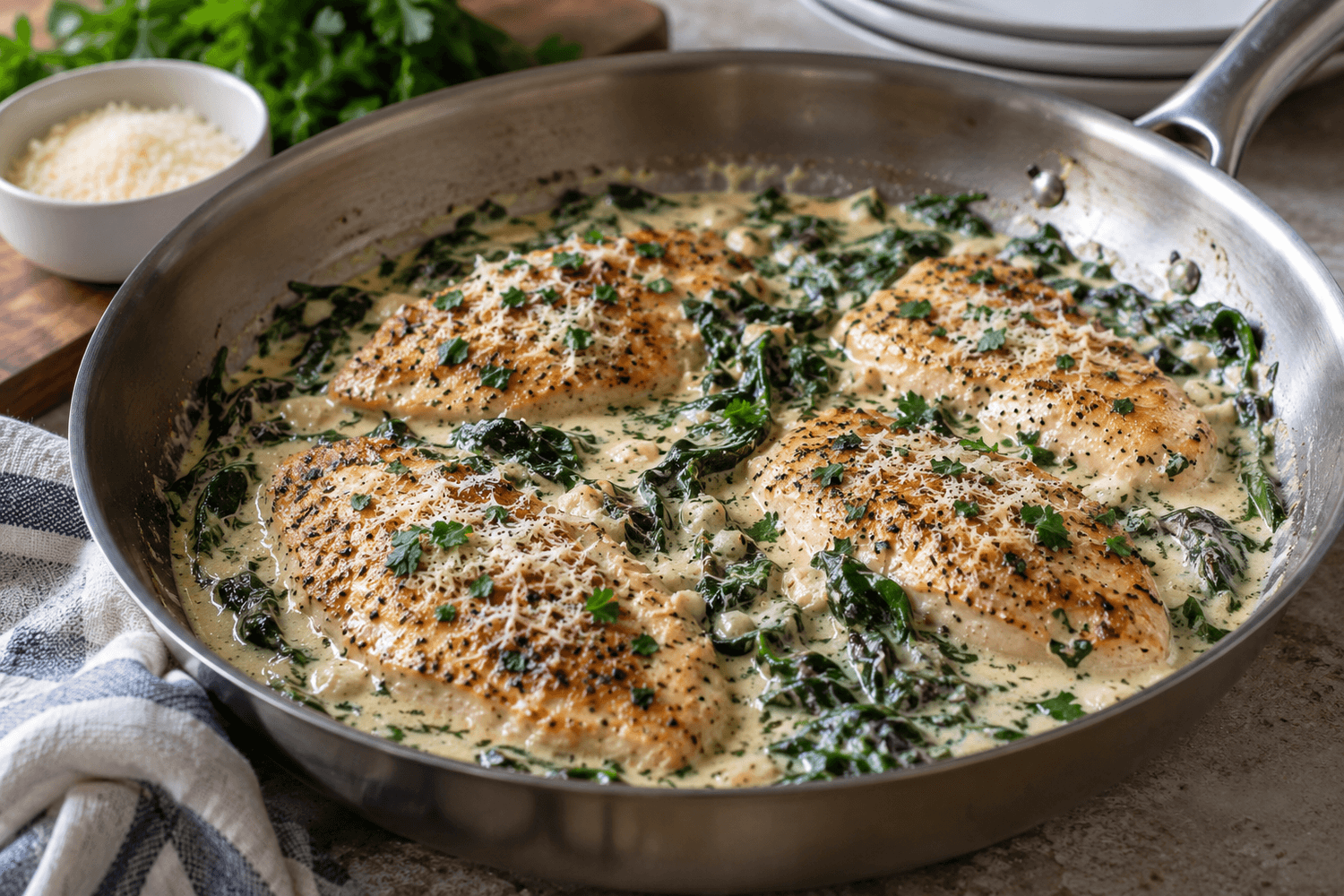
Creamy garlic and spinach chicken skillet with browned chicken breast cutlets in a light Parmesan sauce
HIGH-PROTEIN GLP-1 DINNER

Creamy Garlic & Spinach Chicken Skillet

A creamy one-skillet chicken dinner made with thin chicken breast cutlets, garlic, baby spinach, light cream cheese, plain nonfat Greek yogurt, Parmesan, and chicken broth. The sauce is finished gently over low heat for a smooth, creamy texture without heavy cream.

Servings
4
Yield 4 servings
Prep Time 10 mins
Cook Time 15 mins
Total Time 25 mins
Course Dinner
Cuisine American

Instructions

  • 1
    Prepare the chicken. Pat the chicken cutlets dry. Season both sides with the Kosher Salt and black pepper.
  • 2
    Sear the chicken. Heat a large nonstick skillet over medium-high heat. Add the Olive Oil. Once hot, add the chicken in a single layer. Cook for approximately 3 minutes per side, or until browned and the thickest part reaches 165°F on an instant-read food thermometer. Transfer the chicken to a clean plate.
  • 3
    Cook the garlic. Reduce the skillet heat to low. Add the minced garlic and cook for about 30 seconds, stirring constantly, just until fragrant. Do not brown the garlic.
  • 4
    Build the cream-cheese base. Pour in the chicken broth and scrape up the browned bits from the bottom of the skillet. Add the softened light cream cheese. Whisk gently until the cream cheese is incorporated and the mixture is mostly smooth.
  • 5
    Temper the Greek yogurt. Remove the skillet from the heat for about 30 seconds. Place the Greek yogurt in a small bowl. Whisk 2 to 3 tablespoons of the warm broth mixture into the yogurt until smooth.
  • 6
    Finish the sauce gently. Return the tempered yogurt mixture to the skillet. Keep the heat on low. Add the Parmesan and stir until incorporated. Do not bring the sauce to a vigorous boil.
  • 7
    Wilt the spinach. Add the baby spinach and gently fold it into the sauce. Cook for 1 to 2 minutes, or until the spinach is wilted and the sauce is creamy. If the sauce becomes too thick, stir in 1 to 2 tablespoons additional chicken broth.
  • 8
    Return the chicken. Place the chicken and any accumulated juices back into the skillet. Spoon the sauce over the chicken and warm gently for about 1 minute.
  • 9
    Serve. Divide the chicken and sauce among 4 servings. Garnish with parsley and optional Parmesan.

Recipe Notes

  • The sauce depends on gentle heat, especially after the Greek yogurt is added.
  • Softened cream cheese incorporates more easily than a cold block.
  • Tempering the yogurt with warm broth gives it a gradual temperature transition before it enters the skillet.
  • Thin chicken cutlets are intentional: they reduce cooking time and make the chicken easier to cook evenly.
  • Do not use a hard boil to thicken the sauce.
  • If the sauce becomes too thick, loosen it with a small amount of chicken broth.
  • The finished sauce should be creamy and spoonable rather than stiff.
  • The recipe is moderately seasoned so it can pair naturally with a range of family-style side dishes.

Nutrition Facts

Estimated nutrition per serving (1 chicken cutlet with approx. 1/3 cup sauce):
NutrientAmount
Calories~230 kcal
Protein~36 g
Carbohydrates~5 g
NutrientAmount
Fat~7 g
Fiber~1 g
Sugar~2 g
NutrientAmount
Sodium~500 mg

Substitutions

  • Chicken Thighs: Boneless, skinless chicken thighs can replace breast, producing a richer result (cook to 165°F).
  • Regular Cream Cheese: Can be used instead of light cream cheese (increases calories and fat).
  • Greek Yogurt: Use plain, unsweetened nonfat Greek yogurt only.
  • Chicken Broth: Reduced-sodium vegetable broth can replace chicken broth.
  • Spinach: Regular fresh spinach can replace baby spinach (remove thick stems).
  • Parmesan: Finely grated Pecorino Romano (adjust added salt accordingly).

Storage

Transfer leftovers to a covered airtight container and refrigerate within 2 hours of cooking. Store refrigerated leftovers for 3 to 4 days at 40°F or below. Refrigerate the chicken and sauce together.

Reheating

Stovetop: Reheat portions gently in a skillet over low heat with 1 to 2 tablespoons of chicken broth. Avoid aggressively boiling the sauce.
Microwave: Heat at medium power in short intervals, stirring between intervals. Ensure leftovers reach 165°F.

Make Ahead / Meal Prep

  • The chicken can be trimmed, sliced into cutlets if necessary, and seasoned up to 1 day ahead.
  • The finished recipe can be refrigerated for 3 to 4 days.
  • For meal prep, divide the finished chicken and sauce into individual containers after cooling appropriately and refrigerate promptly.
  • For smaller appetites, portion the recipe into smaller servings before refrigeration so only the amount needed is reheated.

Serving Suggestions

The skillet can remain the shared family centerpiece while individual side portions are adjusted:

  • For a lighter plate, pair it with roasted broccoli, green beans, or a simple green salad.
  • For a larger family-style dinner, serve the skillet with rice or whole-grain pasta.
  • Crusty bread is excellent for enjoying the remaining creamy garlic sauce.
  • Roasted potatoes provide a comforting and naturally satisfying side pairing.
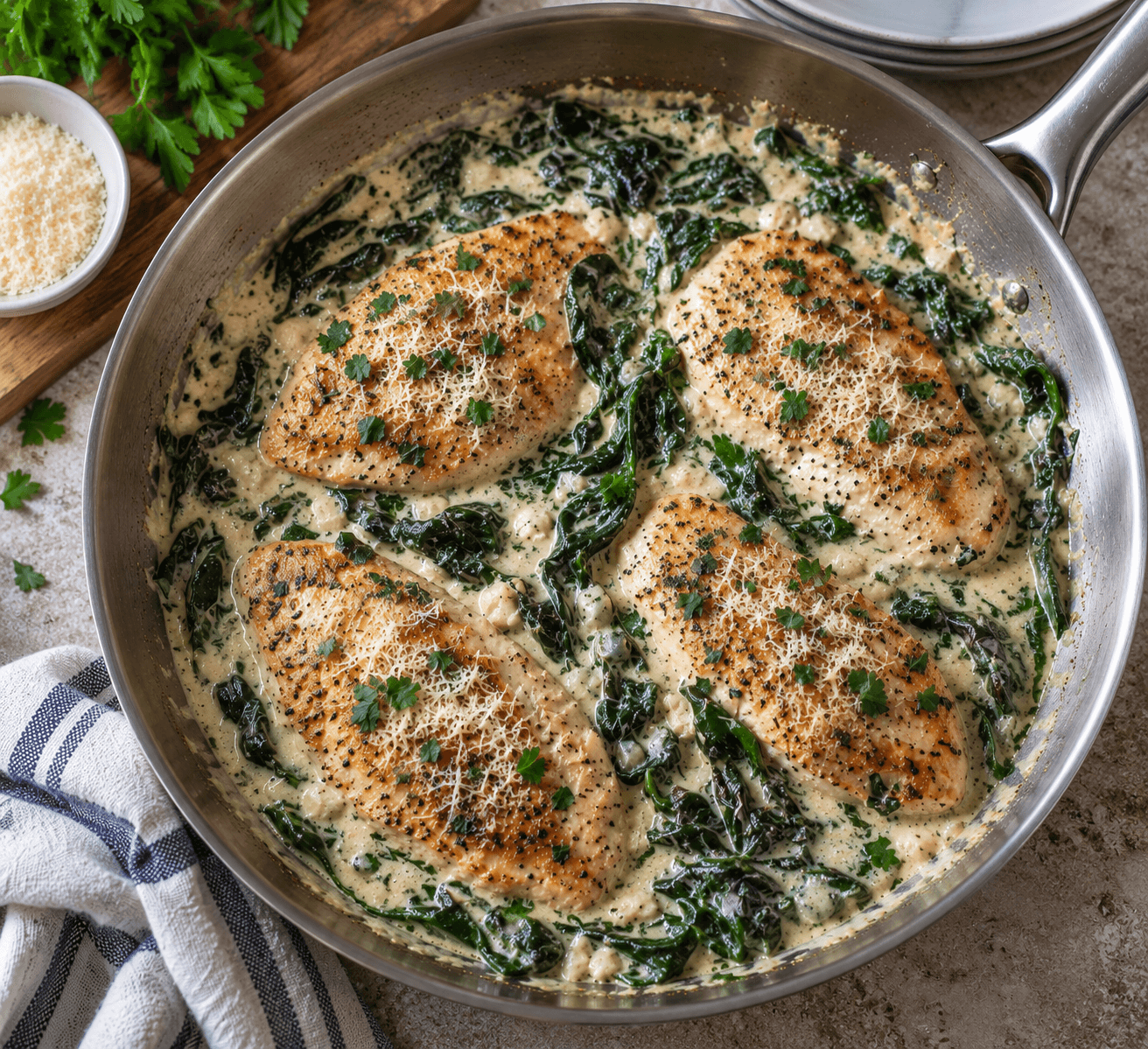
Top view of the creamy garlic spinach chicken skillet for serving

GLP-1 Practical Notes

The main GLP-1 consideration here is practical meal flexibility.

This recipe does not claim to activate GLP-1, improve medication effectiveness, prevent nausea, prevent reflux, or guarantee appetite control.

Instead, it provides a relatively compact, protein-forward dinner that can be portioned according to individual appetite.

If a full serving feels larger than comfortable, a smaller portion can be served and the remainder refrigerated promptly.

Individual tolerance varies, particularly when people are experiencing digestive symptoms or have specific dietary restrictions.

A Useful Family-Dinner Strategy

Prepare one skillet for everyone.

Then adjust the plates.

The chicken and creamy spinach sauce can remain the shared centerpiece. Family members can add different amounts of rice, pasta, potatoes, bread, or vegetables.

This approach reduces the need to prepare a separate meal for the person using a GLP-1 medication.

Common Sauce Mistakes

Boiling the Greek Yogurt

A hard boil is unnecessary and can encourage sauce separation. Keep the finished sauce over low heat.

Adding Cold Yogurt Directly to Hot Liquid

Temper the yogurt first with warm broth from the skillet.

Using High Heat to Thicken the Sauce

Do not turn up the burner to make the sauce thicker. If necessary, allow the cream cheese and Parmesan to provide body and add a small amount of broth for adjustment.

Overcooking the Chicken

Thin chicken cutlets can cook quickly. Use a thermometer and remove the chicken once the thickest portion reaches 165°F.

Oversalting the Sauce

Parmesan and chicken broth can both contribute sodium. Taste the finished sauce before adding additional salt.

Can the Same Dinner Work for the Whole Family?

Yes.

That is one of the strongest practical reasons to make this recipe.

Instead of preparing one "GLP-1 dinner" and one family dinner, use the skillet as the common base.

The person wanting a smaller meal can keep the plate simple. Other family members can add carbohydrate-rich sides or larger portions.

The result is a normal family dinner with flexible serving options rather than a meal that visually separates one person's food from everyone else's.

Frequently Asked Questions

Can I use chicken thighs instead of chicken breasts?

Yes. Boneless, skinless chicken thighs can be substituted, but they contain more fat and may require a different cooking time. Cook all poultry to 165°F internally.

How do you make a creamy chicken sauce without heavy cream?

This recipe combines chicken broth, light cream cheese, plain nonfat Greek yogurt, and Parmesan. The cream cheese supplies body while the yogurt contributes creaminess without using heavy cream.

How do I keep Greek yogurt from curdling in a cream sauce?

Keep the heat low, briefly remove the skillet from direct heat, and temper the yogurt by whisking warm broth into it before adding it to the skillet. Avoid bringing the finished sauce to a vigorous boil.

Is cream cheese okay on a GLP-1 medication?

There is no universal rule that cream cheese is appropriate or inappropriate for everyone taking a GLP-1 medication. Individual tolerance and dietary needs vary. This recipe uses a relatively small amount of light cream cheese as part of the sauce. People with medication-specific or medical dietary questions should follow advice from their healthcare professional.

How much protein is in this garlic chicken skillet?

The final recipe provides approximately 36 grams of protein per serving based on the listed ingredients and four-serving yield. Actual nutrition varies with ingredient brands and the exact size and composition of the ingredients used.

Can I make this chicken skillet ahead of time?

Yes. The finished recipe can be refrigerated for 3 to 4 days. Reheat individual portions gently with a small amount of chicken broth to loosen the sauce.

Can I serve this to family members who are not using GLP-1 medications?

Yes. The skillet is intentionally designed as a shared family dinner. Individual plates can be customized with different portions and side dishes.

Can I use regular Greek yogurt instead of nonfat Greek yogurt?

Yes, plain Greek yogurt with a higher fat percentage can work, but it will change the nutrition profile and make the sauce richer.

Why did my creamy sauce separate?

The most likely causes are excessive heat or aggressive boiling after adding the yogurt. Keep the sauce over low heat and use the tempering step before returning the yogurt mixture to the skillet.

Explore the GLPIANS Bundle

If you want more practical GLP-1 nutrition resources, meal guidance, and related tools beyond individual recipes, explore the GLPIANS Bundle.

Explore the GLPIANS GLP-1 Nutrition Bundle
Link copied to clipboard!