


Light Chicken Alfredo with Broccoli | High-Protein GLP-1 Dinner

4.9 ★
0 people reviewed 🎉 Thanks for review!
Lauren Hayes
Written By Lauren Hayes ✓
Lauren Hayes
Recipe Developer & Culinary Editor

Lauren develops and reviews GLPIANS recipes with a focus on ingredient accuracy, cooking technique, texture, timing, portioning, and reliable home-kitchen execution.

Melissa Grant, MS, RDN
Reviewed By Melissa Grant, MS, RDN ✓
Melissa Grant, MS, RDN
Registered Dietitian Nutritionist

Melissa reviews GLPIANS content for nutrition accuracy, responsible GLP-1 framing, portion guidance, and evidence-based communication.

Daniel Harper, MPH
Fact Checked By Daniel Harper, MPH ✓
Daniel Harper, MPH
Food Safety & Health Fact Checker

Daniel reviews GLPIANS content for food-safety accuracy, including cooking temperatures, food handling, storage, reheating, and source-backed safety guidance.

Light Chicken Alfredo with Broccoli That Still Feels Like Comfort Food

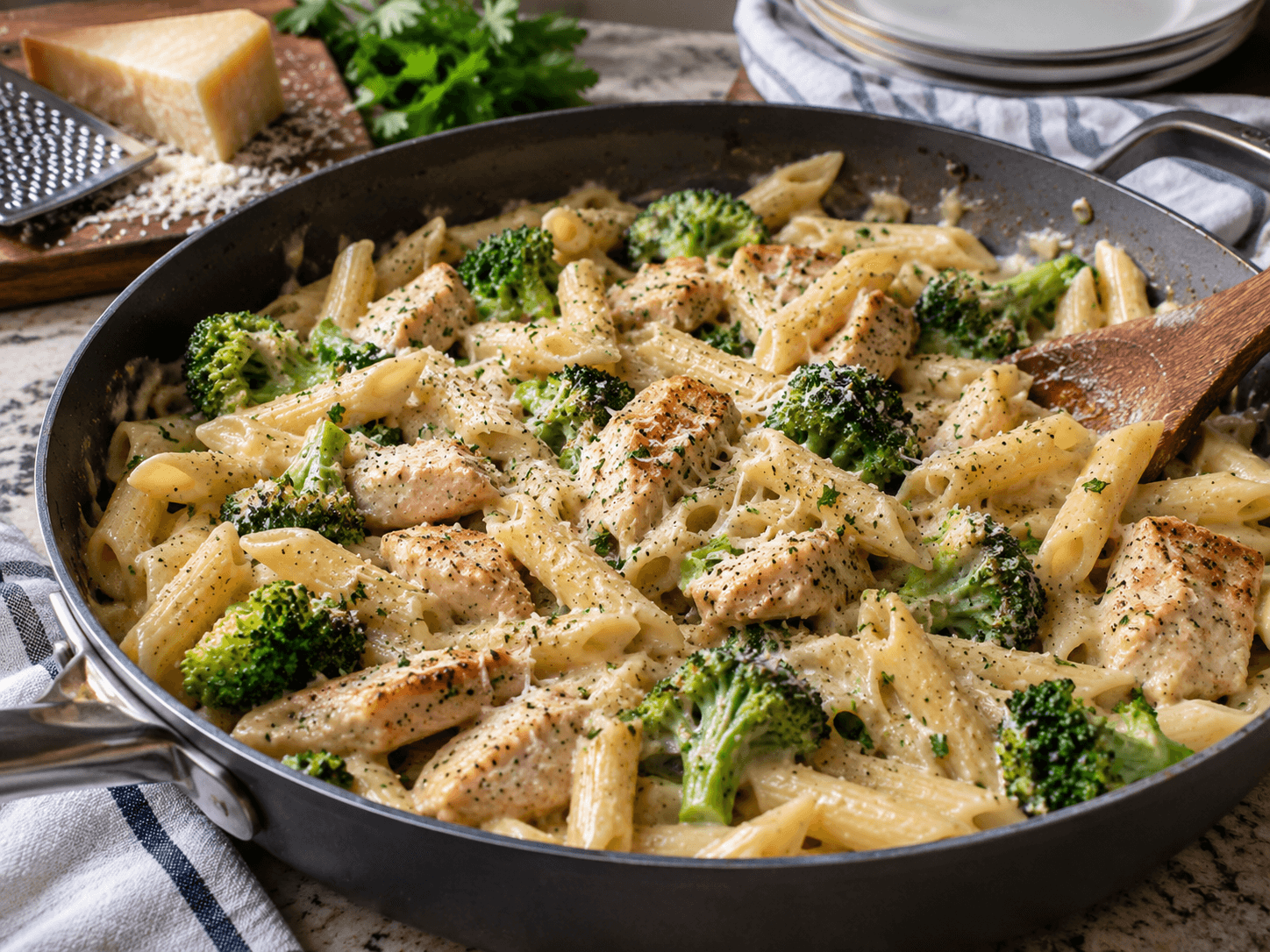
This light chicken Alfredo with broccoli gives you the creamy, cheesy pasta experience you are looking for without building the sauce around heavy cream.

The recipe uses protein-enriched penne, chicken breast, broccoli, chicken broth, reduced-fat cream cheese, and Parmesan. Everything comes together in one deep skillet, and the finished recipe makes 6 portions of approximately 1 3/4 cups each.

The result is creamy enough to feel like Alfredo, but the sauce is intentionally kept relatively loose rather than turning into an especially thick, heavy coating.

Why This Chicken Alfredo Is Different

The biggest change is how the sauce is built.

Instead of starting with a large amount of butter and heavy cream, this recipe uses chicken broth as its primary liquid, then adds reduced-fat cream cheese and Parmesan toward the end.

That gives you three useful things at once:

  • Broth provides the liquid needed to cook the pasta and form the sauce.
  • Cream cheese gives the sauce body and creaminess.
  • Parmesan supplies concentrated cheese flavor without requiring a large amount of cheese.

The pasta also cooks directly in the broth, so the cooking liquid becomes part of the final sauce instead of being discarded.

Why Protein-Enriched Pasta Works Here

The recipe uses protein-enriched penne rather than standard pasta.

For the reference product used in the nutrition estimate, Barilla Protein+ Penne provides 10 grams of protein and 5 grams of fiber per 2-ounce dry serving according to current U.S. product information. (H-E-B | Here Everything's Better)

That makes the pasta itself contribute to the meal's protein and fiber rather than relying entirely on the chicken.

You can use another protein-enriched pasta, but check its package information because protein, fiber, sodium, calories, and cooking behavior can vary between products. For a high-protein breakfast option, consider maintaining the high-protein theme with cottage cheese egg bites.

Why the Broccoli Goes Into the Same Pan

The broccoli is not cooked separately.

Small broccoli florets go into the skillet during the final few minutes of pasta cooking, allowing them to become tender-crisp while the pasta finishes.

That keeps the recipe genuinely one-pan and means you get chicken, pasta, broccoli, and sauce together in each portion.

Cutting the broccoli too large is one of the easiest ways to throw off the timing, so keep the florets relatively small.

How the Lighter Alfredo Sauce Comes Together

The sauce does not need heavy cream to become creamy.

Once the pasta and broccoli are almost finished, the heat is reduced and softened reduced-fat cream cheese is stirred directly into the hot cooking liquid. Parmesan goes in after the skillet comes off the heat.

The important detail is not to aggressively boil the cream cheese.

Low heat and gentle stirring help the cream cheese incorporate smoothly. The sauce should remain loose enough to coat the pasta.

Philadelphia's reduced-fat cream cheese is specifically sold as a reduced-fat cream cheese with one-third less fat than regular cream cheese and is intended for use in recipes including sauces. (Kraft Heinz)

A Practical Portion Strategy for GLP-1 Users

This recipe is designed around portion flexibility, not a promise that it will prevent digestive symptoms or make a GLP-1 medication easier to tolerate.

GLP-1 medications can affect gastrointestinal function. For example, current U.S. prescribing information for semaglutide medications describes delayed gastric emptying and gastrointestinal adverse reactions. (Ask USDA)

That does not mean a particular recipe will prevent nausea, reflux, fullness, vomiting, constipation, or another medication-related symptom.

What this recipe can provide is a practical structure: the full batch is divided into six portions, so someone who prefers a smaller meal can serve less and save the rest. If you are looking for another small-volume GLP-1 dinner, a honey garlic salmon bowl offers similar structural flexibility.

Individual tolerance varies. If a food consistently causes significant discomfort or if you are experiencing persistent or severe gastrointestinal symptoms while taking a GLP-1 medication, discuss those symptoms with your healthcare professional rather than relying on food changes alone.

How to Make the Recipe More Comfortable to Portion

You do not need to change the recipe to create a smaller meal.

Start with a portion that feels appropriate for you, then refrigerate the remainder promptly. If you want another comforting chicken dinner with a different texture, consider a cozy chicken and potato soup.

That approach is especially useful with a creamy pasta recipe because there is no need to prepare a separate small batch every time you want it.

The six-serving baseline also makes the recipe practical for households where different people want different portion sizes.

What Pasta Can You Use?

Protein-enriched penne

This is the default choice and provides the intended nutritional profile used for the estimate.

Chickpea pasta

Chickpea pasta is a workable alternative, but it can have a different texture and cooking time. Check it early rather than assuming it will behave exactly like wheat-based protein pasta.

Regular penne

Regular penne works from a culinary standpoint. The main difference is nutritional: the finished meal will generally have less protein and fiber than the reference version.

Can You Make This Alfredo Without Heavy Cream?

Yes.

This recipe does not use heavy cream.

Instead, the creamy texture comes from reduced-fat cream cheese, Parmesan, and the broth surrounding the pasta.

That is an intentional recipe-development choice rather than a claim that the resulting dish is medically superior or easier for everyone to tolerate.

Why the Sauce Should Be Slightly Loose

The ideal freshly cooked sauce should lightly coat the penne.

It should not look like a thick paste.

There is a practical reason: pasta continues absorbing liquid after cooking, and refrigerated pasta absorbs even more as it sits.

A sauce that looks perfect in the skillet but is already extremely thick will usually become considerably thicker in the refrigerator.

If your finished sauce is too thick, stir in a small splash of broth before serving.

Is This Good for Meal Prep?

Yes.

The recipe was deliberately designed to make six portions, so the entire skillet can be divided into individual containers after cooking. For another GLP-1 meal-prep recipe, moist air-fryer turkey meatballs provide an excellent alternative.

For the best reheated texture, add a small splash of broth or water when reheating.

Microwave the portion in short intervals and stir between them rather than heating the entire serving at once.
GLPIANS
Professional Recipe Collection
Light chicken Alfredo with broccoli and penne in a creamy Parmesan sauce.
HIGH-PROTEIN COMFORT DINNER

Light Chicken Alfredo with Broccoli

A creamy one-pan chicken Alfredo made with protein-enriched penne, tender chicken breast, broccoli, reduced-fat cream cheese, chicken broth, garlic, and Parmesan. The sauce is intentionally lighter and loose enough to coat the pasta without relying on heavy cream.

Servings
6
Yield 6 servings
Prep Time 10 mins
Cook Time 25 mins
Total Time 35 mins
Course Dinner
Cuisine Italian-American

Ingredients

Equipment

Large deep nonstick skillet or sauté pan
Cutting board
Chef's knife
Measuring cups and spoons
Wooden spoon or heat-resistant spatula
Food thermometer

Instructions

  • 1
    Season the chicken. Pat the chicken dry. Toss it with the garlic powder, Italian seasoning, and black pepper.
  • 2
    Brown the chicken. Heat a large, deep nonstick skillet or sauté pan over medium-high heat. Add the olive oil. Once hot, add the chicken in a single layer. Cook for about 5–7 minutes, turning occasionally, until browned and the thickest pieces reach 165°F on a food thermometer. Transfer the chicken to a clean plate.
  • 3
    Build the cooking liquid. Reduce the heat to medium. Add the minced garlic to the same pan and cook for about 30 seconds, stirring constantly. Pour in the chicken broth and scrape up the browned bits from the bottom of the pan.
  • 4
    Cook the pasta. Add the dry penne and stir well so the pasta is mostly submerged. Bring the broth to a steady simmer. Cook uncovered for about 7 minutes, stirring frequently to prevent sticking.
  • 5
    Add the broccoli. Stir in the broccoli. Continue simmering for 4–6 minutes, stirring frequently, until the pasta is al dente and the broccoli is tender-crisp. If the pan becomes dry before the pasta is tender, add broth 2 tablespoons at a time.
  • 6
    Create the Alfredo-style sauce. Reduce the heat to low. Add the softened cream cheese and stir continuously until it melts into the cooking liquid and forms a smooth, creamy sauce.
  • 7
    Add the Parmesan. Remove the skillet from the heat. Stir in the Parmesan until melted and evenly incorporated. If the sauce is thicker than desired, loosen it with a small splash of additional broth.
  • 8
    Return the chicken. Add the cooked chicken and any accumulated juices from the plate back to the skillet. Toss gently until the chicken is evenly distributed and heated through.
  • 9
    Check the final texture. The sauce should lightly coat the pasta and broccoli rather than form a very thick layer. Let the skillet stand for 2 minutes before serving; the sauce will continue to thicken slightly.
  • 10
    Serve. Divide the finished recipe into 6 portions of approximately 1 3/4 cups each and serve warm.

Recipe Notes

  • Use a large, deep skillet: The pasta, broccoli, chicken, and sauce need enough room to cook and be tossed without overflowing.
  • Cut the chicken evenly: Similar-size pieces cook at approximately the same rate.
  • Keep the broccoli small: Small florets can finish in the same cooking window as the pasta.
  • Stir the pasta frequently: Pasta cooked directly in broth can stick to the bottom of the skillet.
  • Use softened cream cheese: It incorporates more easily into the hot cooking liquid.
  • Do not boil the cream cheese aggressively: Low heat helps maintain a smoother sauce.
  • Do not over-reduce the sauce: The pasta continues absorbing liquid after cooking, and the sauce will thicken as it stands.
  • Protein pasta varies: Different protein-enriched pastas have different cooking characteristics. Use the package instructions as a secondary reference for doneness.
  • Salt is intentionally omitted: Parmesan, chicken broth, and cream cheese provide salt. Use low-sodium broth so the final dish is easier to adjust.
  • Portion flexibility: The six-serving baseline is useful for smaller portions. You do not need to finish a full serving simply because the recipe is portioned that way.

Nutrition Facts

Estimated nutrition per serving (approx. 1 3/4 cups):
NutrientAmount
Calories~340 kcal
Protein~30 g
Carbohydrates~32 g
NutrientAmount
Fat~10 g
Fiber~5 g
Sugar~4 g
NutrientAmount
Sodium~450 mg

Substitutions

  • Protein Penne: Chickpea pasta (check early for texture) or regular penne (lower protein/fiber).
  • Chicken breast: Boneless, skinless chicken thighs (richer, higher calorie).
  • Reduced-fat cream cheese: Neufchâtel or regular cream cheese (increases fat).
  • Broccoli: Cauliflower florets.
  • Chicken broth: Low-sodium vegetable broth.
  • Parmesan: Finely grated Parmigiano-Reggiano.

Storage

Transfer leftovers into shallow airtight containers and refrigerate within 2 hours of cooking. Keep refrigerator at 40°F or below. Use refrigerated leftovers within 3–4 days for food safety.

Reheating

Microwave: Place portion in a bowl, add 1-2 tbsp broth, cover loosely. Microwave in 30-45 second intervals, stirring well, until 165°F.
Stovetop: Heat gently in a small skillet with a splash of broth. Avoid high heat.

Make Ahead / Meal Prep

  • Prepare the full recipe, allow it to stop steaming heavily, then divide it into 6 portions and refrigerate promptly.
  • For the best reheated texture, keep the sauce slightly looser at the end of cooking than you would for immediate serving.
  • When reheating, add 1–2 tablespoons broth or water per portion and stir during heating.
  • This is particularly practical for meal prep as the same batch provides complete portions without requiring separate side prep.

Serving Suggestions

Keep the bowl simple and elevate your experience with these touches:

  • Serve the chicken Alfredo as a complete pasta-and-vegetable dinner.
  • Add a simple green salad if you want additional volume and that fits comfortably with your meal.
  • For a smaller meal, serve less than the baseline portion and refrigerate the remainder.
  • A small amount of freshly grated Parmesan can be added at serving if desired.
  • Fresh parsley can be used as an optional garnish for color and freshness; it is not necessary to the recipe.
Serving Suggestions for Light Chicken Alfredo

GLP-1 Practical Notes

The most useful GLP-1 feature of this recipe is flexibility.

It provides:

  • a substantial protein component from chicken and protein-enriched pasta;
  • broccoli incorporated directly into the meal;
  • a sauce that does not depend on heavy cream;
  • six baseline portions;
  • straightforward leftovers;
  • easy portion reduction without changing the recipe.

These characteristics can make the recipe practical for someone who prefers smaller meals, but they do not guarantee better tolerance or any particular medical outcome.

GLP-1 medications differ, and individual food tolerance differs as well. Current prescribing information for semaglutide medications identifies gastrointestinal adverse reactions and delayed gastric emptying among relevant considerations. (Ask USDA)

If a creamy pasta dish does not feel comfortable for you, do not assume that changing the recipe will resolve a medication-related symptom.

Common Mistakes to Avoid

1. Using a shallow or undersized pan

The pasta and broccoli need enough space to cook evenly. Use a large, deep skillet.

2. Adding the cream cheese while the pan is boiling aggressively

Reduce the heat first. Gentle heat helps the cream cheese blend into the cooking liquid.

3. Letting the pan become completely dry

The pasta is cooking directly in the broth. Stir regularly and add additional broth a few tablespoons at a time if necessary.

4. Cutting the broccoli too large

Large florets can remain firm while the pasta is already done. Small florets are better suited to the short cooking window.

5. Making the sauce too thick

Remember that the pasta continues absorbing liquid after cooking. Keep the finished sauce slightly looser than your final desired consistency.

6. Using chicken color as the only safety check

Chicken should reach 165°F internally when checked with a food thermometer. USDA specifically advises using a thermometer rather than relying on appearance alone. (Ask USDA)

How to Keep Leftovers Creamy

Refrigerated Alfredo-style pasta naturally becomes thicker.

That is not necessarily a sign that anything went wrong.

For the best reheated texture:

  1. Put one portion into a microwave-safe bowl.
  2. Add 1–2 tablespoons broth or water.
  3. Cover loosely.
  4. Heat in short intervals.
  5. Stir between intervals.
  6. Continue until evenly hot.

The added liquid loosens the sauce while reheating.

Frequently Asked Questions

Can I use regular pasta instead of protein pasta?

Yes. Regular penne is a compatible culinary substitute, but the finished recipe will have different protein, fiber, carbohydrate, and calorie values.

Can I use chickpea pasta?

Yes. Chickpea pasta can work, but its cooking behavior varies by brand. Check it early for texture and avoid overcooking.

Is this traditional Alfredo sauce?

No. This is a lighter Alfredo-style sauce developed with chicken broth, reduced-fat cream cheese, and Parmesan rather than a traditional heavy-cream-based sauce.

Does this recipe contain heavy cream?

No. Heavy cream is not used.

How many servings does this recipe make?

The base recipe makes 6 servings, with approximately 1 3/4 cups per serving.

Can I make the portion smaller?

Yes. The recipe does not need to be changed. Serve less than the baseline portion and refrigerate the remainder promptly.

Can I use chicken thighs?

Yes. Boneless, skinless chicken thighs are compatible, but they will make the finished dish richer and generally higher in fat and calories.

How long does chicken Alfredo last in the refrigerator?

For food safety, refrigerate it within two hours and use refrigerated leftovers within 3–4 days. (U.S. Food and Drug Administration)

How do I reheat chicken Alfredo without drying it out?

Add 1–2 tablespoons broth or water per serving and reheat gently, stirring between intervals.

Can I freeze this chicken Alfredo?

Freezing is not recommended for best texture. Cooked pasta and the cream-based sauce can change texture after freezing and thawing. Refrigerated meal prep is the preferred storage approach for this recipe.

Is this recipe guaranteed to be easier to tolerate on a GLP-1 medication?

No. The recipe is designed around a lighter sauce and flexible portions, but individual tolerance varies. It should not be presented as a treatment or prevention strategy for medication-related gastrointestinal symptoms.

Why is the Alfredo sauce loose instead of very thick?

The sauce is intentionally kept relatively loose because the pasta continues absorbing liquid as it stands and becomes thicker after refrigeration.

Your Next GLPIANS Step

Want a clearer picture of how your current meals, portions, and everyday habits fit into your GLP-1 routine? Take the free GLP-1 Success Audit to identify areas worth reviewing.

Take the Free GLP-1 Success Audit
Link copied to clipboard!