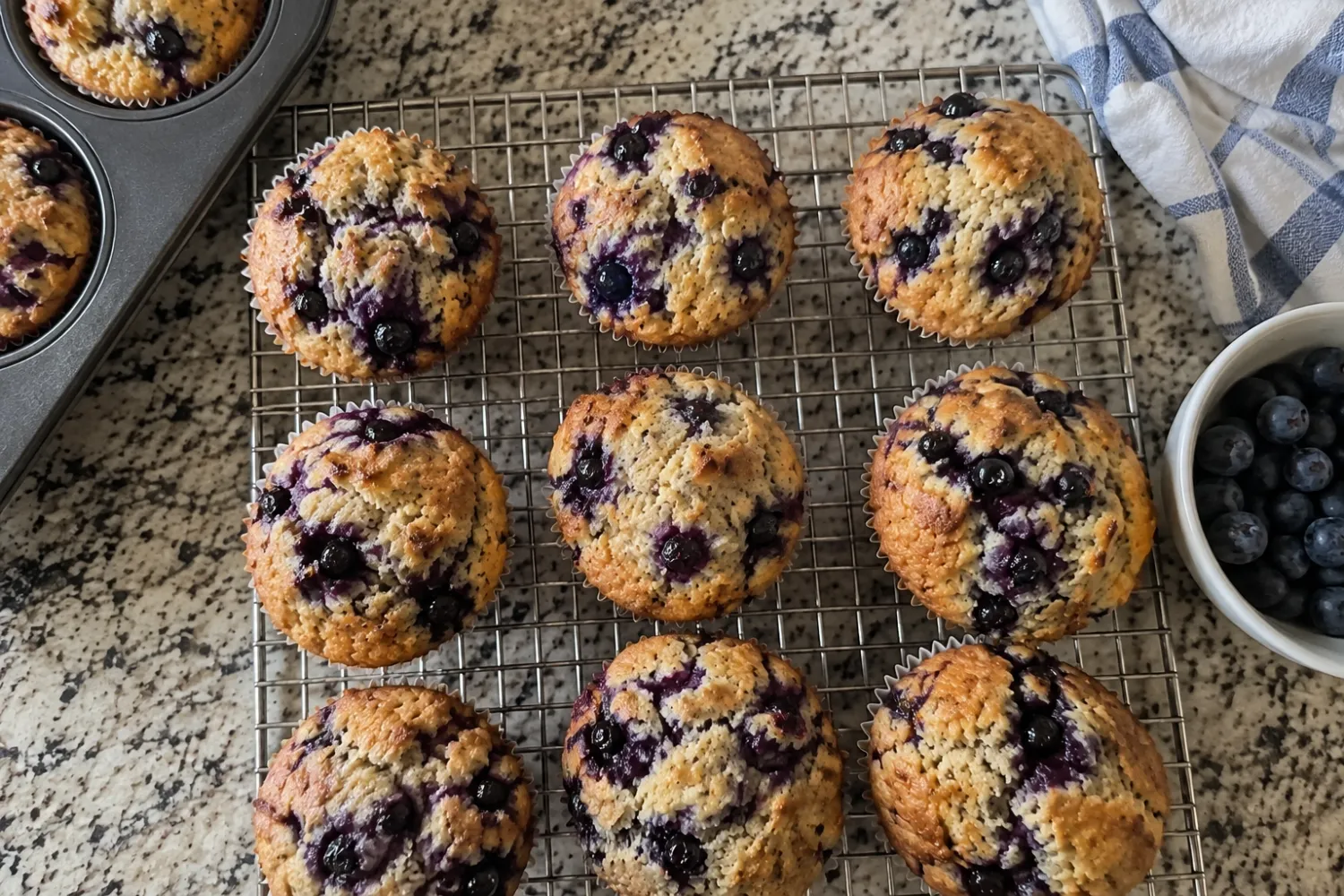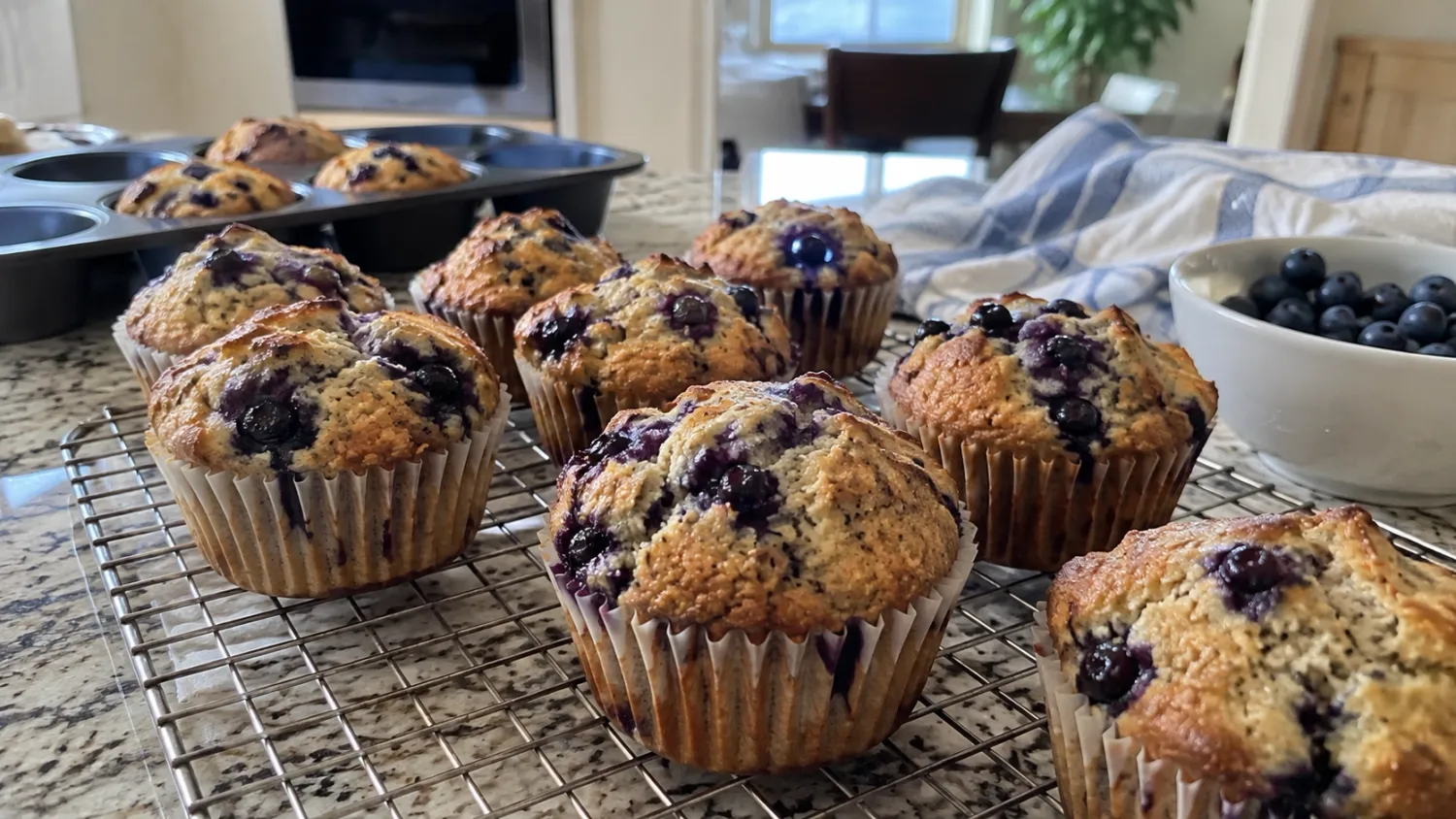



A Fiber-Forward Blueberry Muffin Built for a Smaller Morning Meal
These Oat Fiber & Psyllium Husk Blueberry Morning Muffins combine almond flour, oat fiber, whole psyllium husk, Greek yogurt, and wild blueberries in a tender, lightly sweetened muffin that can be eaten whole or divided into a smaller portion.
The recipe makes 12 standard muffins. Each muffin provides an estimated 190 calories, 6 grams of protein, 14 grams of carbohydrate, and 5.6 grams of dietary fiber.
For readers using GLP-1 medications, the relevance is practical rather than medicinal. Constipation is among the common gastrointestinal adverse reactions listed in current U.S. prescribing information for some GLP-1–based medications, including Zepbound. That does not mean every medication or every person has the same experience, and this muffin should not be presented as treatment for a medication side effect.
The useful features are simpler: a small physical portion, measurable fiber, freezer-friendly leftovers, and the ability to start with half a muffin rather than forcing a larger breakfast.
What Makes This Psyllium Muffin Different
Adding psyllium or oat fiber to a normal almond-flour muffin without changing the liquid balance is likely to produce a dry, dense, or gummy result.
This formula is built around that problem.
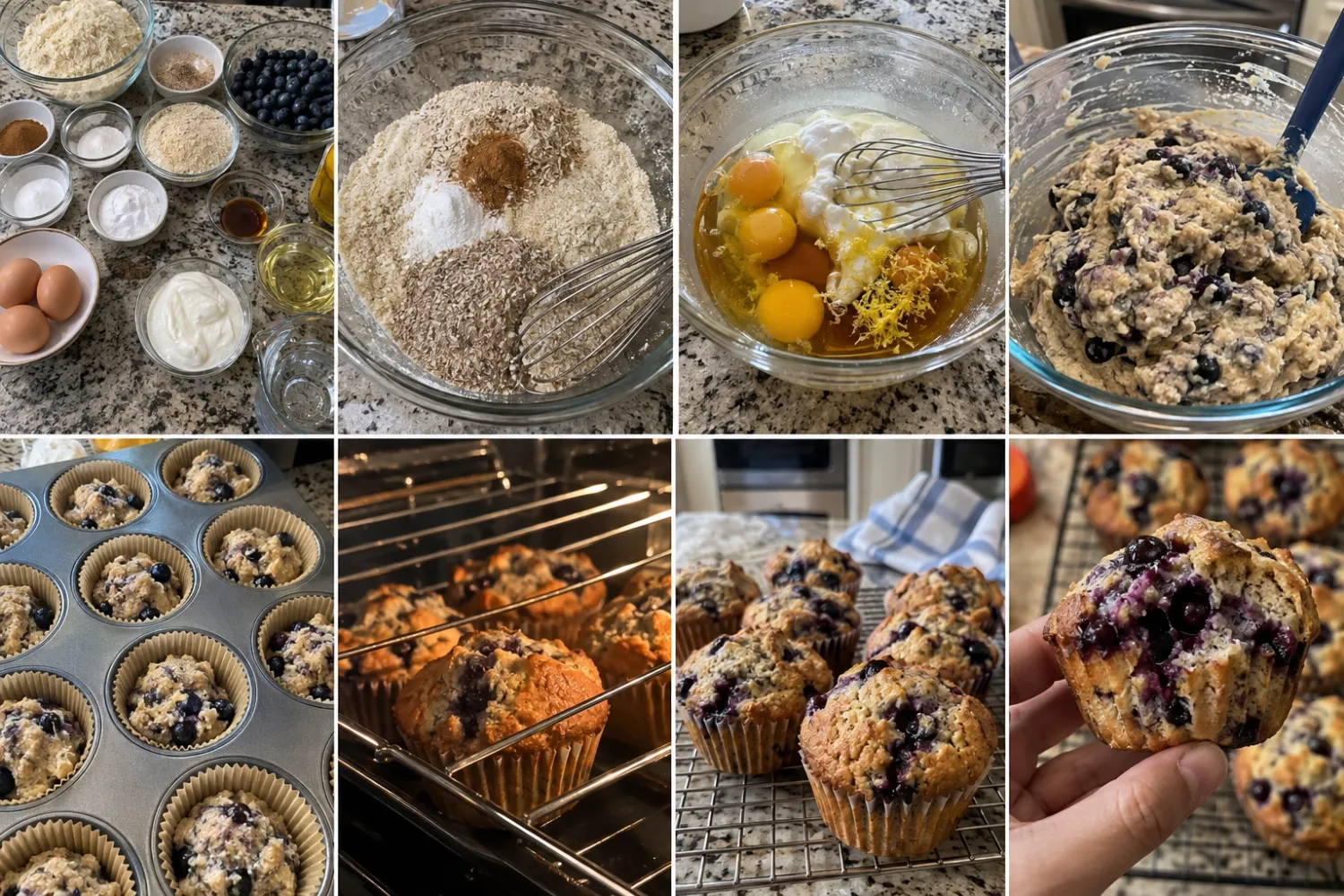
Almond flour provides fat, protein, and tenderness. Greek yogurt, eggs, water, maple syrup, and avocado oil provide enough moisture for the concentrated fiber ingredients to hydrate. The batter then rests briefly before baking so hydration starts in the mixing bowl instead of occurring unpredictably after the muffins enter the oven.
The result is intended to be a muffin first—not a spoonful of fiber disguised as breakfast.
How Much Fiber Is in One Muffin?
One muffin contains an estimated 5.6 grams of total dietary fiber.
Of that amount, approximately 1.0 gram of soluble fiber is attributable specifically to the psyllium husk based on representative pure whole-husk composition data.
That distinction matters.
It would be inaccurate to say the muffin contains “exactly 1 gram of total soluble fiber,” because almond flour, blueberries, and other plant ingredients contain their own fiber fractions, and recipe-level soluble-fiber data are not precise enough to justify that exact claim.
The approximately 5.6 grams of total fiber equals about 20% of the FDA Daily Value of 28 grams, although individual daily fiber needs vary.
Why Psyllium Is Used Here
Psyllium is a gel-forming fiber. When exposed to liquid, it hydrates and increases viscosity.
That property matters in two different ways.
In baking, it helps bind water and contributes structure.
In gastrointestinal research, psyllium is also one of the fiber supplements specifically addressed in constipation guidance. The joint American Gastroenterological Association/American College of Gastroenterology guideline gives fiber supplementation, specifically psyllium, a conditional recommendation for chronic idiopathic constipation. That evidence concerns constipation management generally; it is not GLP-1-specific evidence and should not be rewritten as proof that these muffins treat medication-induced constipation.
Is Soluble Fiber Always Better Than Insoluble Fiber During GLP-1 Treatment?
No.
The original idea that soluble fiber is simply “better” and insoluble fiber is “harsh” is too broad.
Psyllium has useful evidence in constipation management, but there is no basis for claiming that every person using a GLP-1 medication should preferentially eat soluble fiber or avoid insoluble fiber.
That point is especially important here because oat fiber itself is predominantly insoluble fiber, depending on the specific product. One current oat-fiber manufacturer describes its product as almost entirely insoluble fiber.
This recipe therefore does not depend on a simplistic soluble-versus-insoluble hierarchy. It combines different fiber sources in a measured baked portion and emphasizes individual tolerance.
Why Oat Fiber Is Not Oat Flour
Oat fiber, oat flour, and oat bran may all have “oat” in the name, but they cannot be treated as interchangeable ingredients.
Oat flour contains starch and behaves like flour.
Oat bran contains the bran fraction of the grain and contributes its own flavor, nutrients, and water-binding behavior.
Oat fiber is a concentrated fiber ingredient that absorbs significant moisture and contributes very little conventional flour structure.
That is why replacing the oat fiber with oat flour—or measuring an unusually dense oat-fiber product carelessly—can materially change the muffin.
For this formulation, 30 grams is the authoritative oat-fiber amount.
How Almond Flour Helps Keep the Muffins Tender
Almond flour offsets some of the textural challenges created by concentrated fiber.
Its naturally occurring fat contributes tenderness. Its protein and finely ground solids help build the muffin crumb. Because the formula uses almond flour rather than relying only on oat fiber and psyllium, the finished muffin can stay softer without requiring a large quantity of added sugar.
The maple syrup is therefore present mainly for mild sweetness, moisture, and flavor rather than as the primary structural ingredient.
How Much Liquid Should You Have With a Fiber-Dense Muffin?
There is no authoritative U.S. guideline specifying an exact number of fluid ounces that must accompany a baked psyllium muffin.
That is important because guidance for a psyllium supplement cannot automatically be converted into a medical rule for a muffin in which the fiber has already been hydrated and baked.
What is well supported is the broader principle: when dietary fiber intake increases, adequate fluid intake matters. NIDDK advises drinking plenty of water and other liquids when eating more fiber and recommends increasing fiber gradually so the body can adapt.
For everyday use, pairing a muffin with a normal glass of water is a practical habit for someone who is not under a fluid restriction. It should not be presented as a prescribed dose of water.
Why Starting With Half a Muffin Can Be Useful
The half-muffin suggestion is a portion strategy, not a medical dose.
A full muffin provides about 5.6 grams of dietary fiber. Someone already accustomed to a fiber-rich diet may tolerate that comfortably.
Someone whose food intake has recently been low—or whose usual diet contains little concentrated fiber—may prefer to start with half.
That approach also fits reduced appetite: half can be eaten now and the other half saved rather than forcing an entire portion.
Individual tolerance matters more than the serving number printed on a recipe card.
Why Wild Blueberries Work Well Here
Wild blueberries are smaller than standard cultivated blueberries, so they distribute through the thick batter more evenly.
Their sweet-tart flavor also helps a lightly sweetened muffin taste brighter without requiring substantially more maple syrup.
Fresh berries should be dry before folding into the batter. Surface water adds moisture in concentrated pockets and can increase streaking.
Frozen wild blueberries are a workable substitution but should go into the batter still frozen.
What Makes This Relevant to a GLP-1 Eating Routine?
There is no ingredient in this recipe that “activates GLP-1,” makes medication work better, guarantees appetite control, prevents constipation, or guarantees weight loss.
Its GLP-1 relevance comes from practical characteristics:
- one defined muffin per serving;
- easy half-portion option;
- meaningful dietary fiber in a small physical volume;
- freezer-friendly leftovers;
- mild flavor;
- no need to prepare a large breakfast;
- portable format;
- ability to pair with a separate protein food when desired.
That makes the muffin potentially useful without turning ordinary nutrition into medical treatment.
Building a More Flexible Breakfast Rotation
Not every breakfast needs to solve the same nutritional problem.
These muffins are intentionally fiber-forward. On a morning when protein is the bigger priority, the GLPIANS High-Protein Greek Yogurt Parfait Prep provides a cold, no-cook alternative with a very different texture and meal format.
Using distinct options can be more practical than trying to make one breakfast excessively high in protein, fiber, volume, and every other nutritional target at once.
How to Store the Muffins Without Ruining the Texture
Let the muffins cool completely before enclosing them.
Warm muffins release steam. If that moisture is trapped in a sealed container, the surface can become sticky and the crumb can feel wetter.
For routine use, keep them airtight for up to one day at room temperature or refrigerate for up to four days.
For longer storage, freeze individual muffins after they are fully cool.
A short microwave warm-up is enough for refrigerated muffins; extended heating tends to make psyllium-containing baked goods less pleasant rather than softer.